Appingine
Let's Discuss Your Tech Solutions

Camilla Lawrance

 02/19/2026

APIs (Application Programming Interfaces) are the unsung heroes when it comes to app speed. It gives users a free and smooth experience, whether you are checking the weather on your phone actively, paying for coffee with a tap or even logging into a website via Google; everything seems fluid just by a simple handshake within the app.
But what is api development? And how are these "handshakes" or “bridges” actually built? API development isn't just about writing code but it is more like designing a bridge that is sturdy enough to handle millions of requests but simple enough for any developer to cross. In this blog, we have discussed the bridge, handshakes or in simple words, API in detail. So read the full blog to find out how to develop your very own API along with its terminology, importance and more.
Also, a list of bulls like Stripe, Plaid, Twilio and the list goes on, are mentioned so you know that API is not something unusual, but is used globally to take the software system to the next level. Our top API development specialists take full responsibility to help thousands of businesses scale and automate their workflows without rebuilding infrastructure from scratch.
Now, if you are wondering how these APIs are useful? By offering faster go-to market, superior user experience and reduced operational costs, APIs allow the exchange of data across various systems and platforms, such as Mobile applications, Web applications and IoT solutions.
To state a strong hold of the API, companies strategically recognized up to 12.7% with higher market capitalization and dramatically increased retention by offering frictionless services.
If you already know how API works and want to get your very own API developed and tested then hire our team today!
Hire API ExpertsThe major advantage is that you no longer create features and functionalities from scratch, but it is to smartly use APIs when you have them in the process. By adopting scalability, innovation and interoperability in the latest APIs development procedures, API has given life to your app idea and transformed it beautifully.
APIs are categorized in four main types:
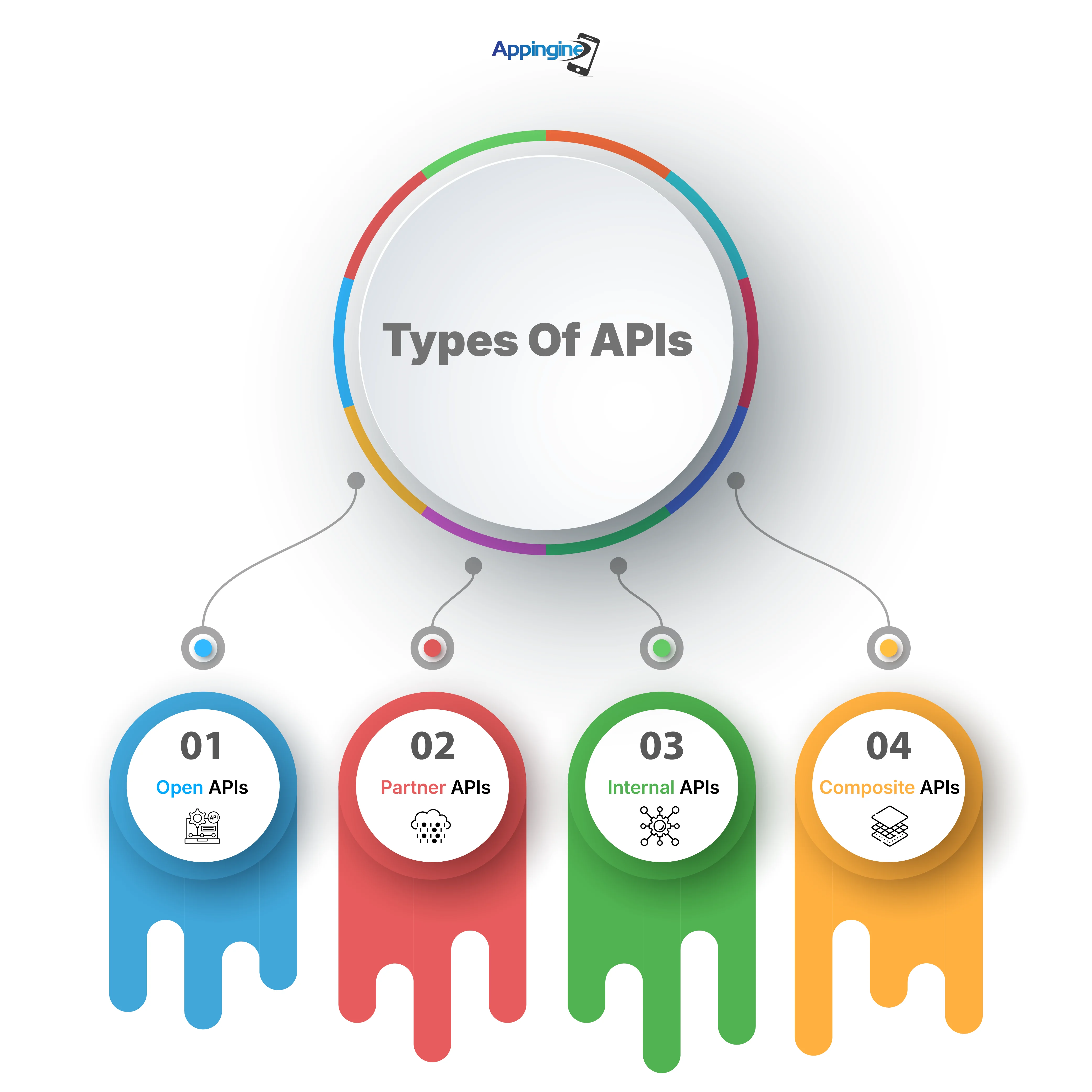
Open APIs are available to any developer or third-party business that promotes innovation and seamless integrations. This API is commonly used to build interconnections in social media platforms, payment gateways, mapping services and more which enable apps to work together seamlessly.
Partner APIs are shared only with specific business partners by providing full access to internal systems along with enhancing collaboration. For example, sharing inventory or order data with trusted suppliers.
Internal APIs are also known as private API which are used exclusively within an organization to streamline operations. They securely connect internal tools, databases and services while ensuring smooth communication between different systems.
Into a single API call, composite APIs work together with multiple services or data sources. This makes it efficient to access complex data without sending multiple requests and save time and resources simultaneously.
The most widely adopted architectural style API is due to simplification in app development. RESTful API architecture works as a gold standard for web services while containing all the necessary data for processing. Operating over HTTP/HTTPS, these APIs depend on the client-servers where every data is processed and eliminate the need for the server to store context easily.
This resource-based system identifies assets by taking full advantage of the HTTP standard method, which includes GET, POST, PUT and DELETE, while managing interactions. Because they align with the universal protocol, RESTful API architecture and list of services are exceptionally flexible and easy to maintain, which makes them the backbone of modern web integration.
If you are developing an enterprise-level app that offers services like financial and banking, then SOAP (Simple Object Access Protocol) is primarily favored. Unlike the more flexible REST, SOAP relies exclusively on XML for message formatting and can operate over multiple protocols, including HTTP and SMTP.
While being more complex and difficult to implement, this complexity comes with a collection of advantages that are listed as follows:
This combination of strict security measures makes it the go-to choice for legacy systems and organizations requiring maximum reliability and data integrity.
Also Read: How To Develop a FinTech Mobile App
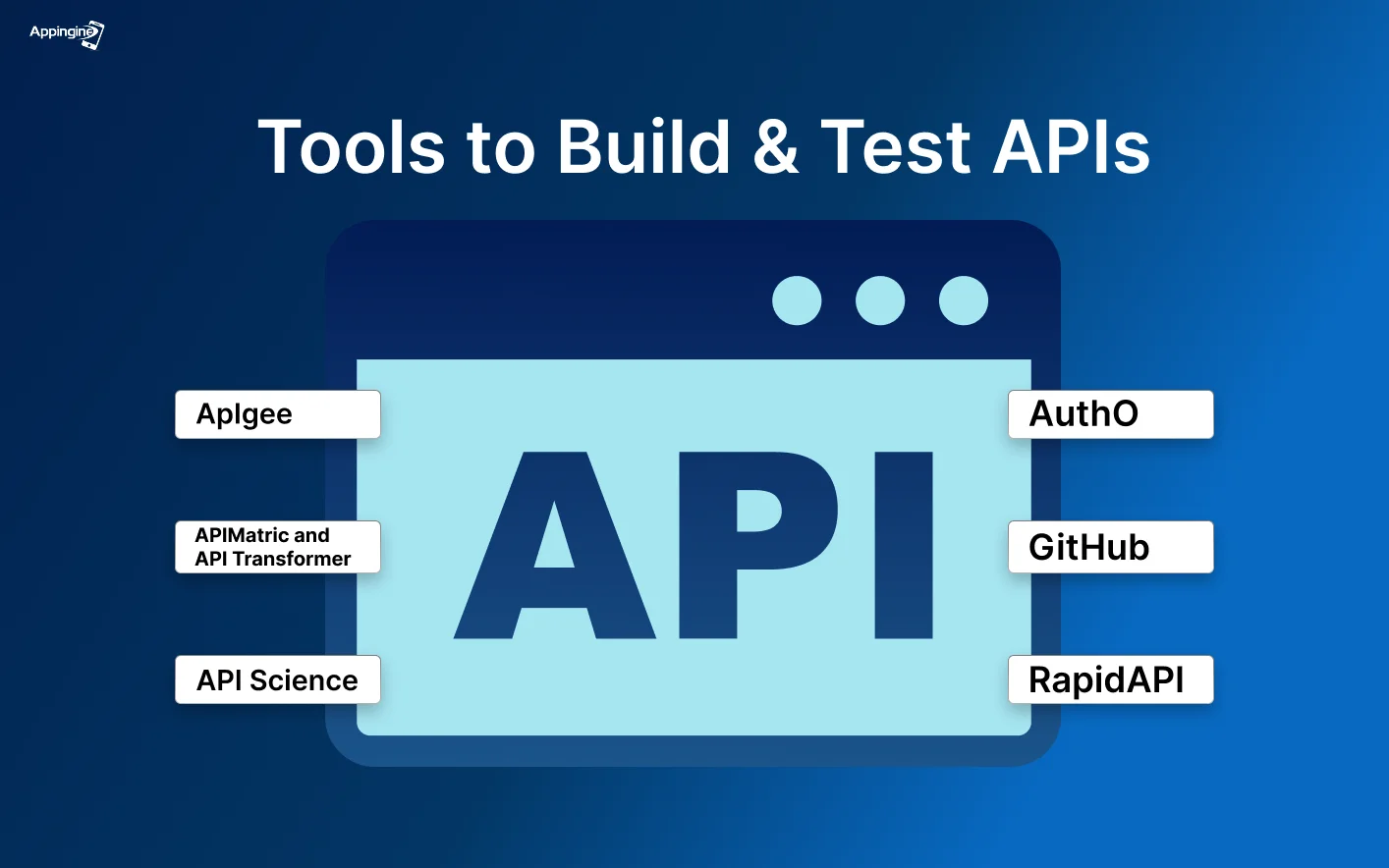
In recent years of the advancement in the digital world, the developers of the top-tier api development companies like Appingine have noticed a change in the development of API. And there are certain tools involved in this evolution, some of which are listed below according to the phases of the software development.
Postman: By offering a user-friendly interface along with smooth version control integration, Postman API allows developers to design, mock, test, and create documents easily.
Swagger/OpenAPI: A toolset that supports a standard way to define API structure and endpoints while allowing developers to design, build APIs, document and consume RestAPIS efficiently.
Insomnia: A modern tool used to build APIs that helps developers design and debug REST, GraphQL and gRPC APIs without difficulty.
Newman: Undoubtedly, Newman is a useful CLI companion in Postman that makes it easier for developers to automate API tests as part of CI/CD pipelines.
SoapUI: A functional API development tool that is especially designed for SOAP and REST APIs. It is helpful in performing tests, security, and functionalities.
Rest Assured: A Java-based library, which plays an incredible role in testing Rest API. Are you looking for a tool that you can integrate while testing into their JAVA projects? Then, this is a good catch for you.
API Fortress: To monitor the real-time API performance along with automation testing, API Fortress is used.
Prometheus: When the targeted API is combined with Grafana (Data Visualization of API metrics), there comes Prometheus.
Datadog: Last but not least, we have another API testing & monitoring tool that provides insight into certain API essentials, including performance of the API development platform, errors and overall health.
OWASP ZAP: Taking security measures seriously is important. And for that, an open source tool, OWASP ZAP, is used to identify vulnerabilities in Web applications. Also, to detect critical issues such as SQL Injection, Cross-Site Scripting (XSS), and others within APIs.
Burp Suite: Now, software assessments and performing penetration testing within the APIs have become easier than ever with the Burp Suite.
Other than the above-mentioned APIs, there is a vast collection of API development tools that are utilized according to the requirements. Below, we have mentioned some for you so you don’t have to struggle to get the most out of the top API development services.
Now that we have seen the type of APIs based on the design and technologies used for the development of the project, let's see how these API really works.
An Application Programming Interface (API) works as a bridge, a connection that allows two different software systems to communicate with one another easily.
When one application needs data or functionality from another system, it sends a request to the API with specific parameters, then the request is forwarded to the server with the help of an API, where the required processing is done, and then the request–response Lifecycle takes place. This lets apps share data and features securely without exposing any internal logic.
Here are some of the best practices that one must consider for the development of an API.
Before you work on any project, whether an app or even API creation, it is important to make plans to keep the data protected. For that, a secure API is built with some authentication & authorization protocols. You must be wondering why it is considered to be a red/alert zone.? Here are certain reasons for that:
Now, the very next thing that comes to mind, what are the possible methods to keep your API protected, authentic, and authorized? Well, we have listed them below:
Next in line is the documentation; consider providing a detailed instruction to the developers to use or to integrate your API. Your documentation will act as an asset for them to collect the essential references and include the functions, classes, return types and arguments of your API.
Not compromising on the speed and performance of the API is a major loophole to connect to have a smooth workflow. Therefore, the developers at Appingine consider Rest APIs in contrast to SOAP to maintain potential speed. There are some APIs that need to give an immediate response. For better understanding, we have an example of a dashboard of a stock market that shows real-time stock data.
Setting limits on the number of API requests a user can make in a given time frame helps in keeping your system running smoothly. By preventing traffic spikes from exceeding expected demand, you protect your servers from overload and ensure your apps stay reliable for a longer period.
Turn data logging into a superpower for your API by capturing request activity and failure rates. You gain clear visibility into what’s working and what needs to be fixed by fueling smarter improvements and long-term success.
Before the launch, ensure the reliability, fast performance, and security of your API by putting it through rigorous testing. Whether using in-house test scripts or trusted tools like BlazeMeter and Loader, this phase helps in catching issues as early as possible and sets your API up for success.
APIs are transforming business like social media that has given a new shape to human connections by making interactions easy and scalable. Instead of connecting people, APIs connect applications and services that allow businesses to expand capabilities and create exceptional user experiences. The API creation offers clear value for every modern business in several industries, from enabling a local bookstore to access external inventory to streamlining operations across platforms. Some more reasons that will make you grab the opportunity to build an API for your platform immediately are listed for you:
Web users today expect services that anticipate their needs within a snap and a strong ecosystem of APIs is key to meeting the growing demands that are keeping users engaged with your platform.
Take Evernote as an example, which organizes and manages notes efficiently while letting users work across multiple apps. By integrating with Gmail, Slack, Microsoft Teams and other major apps through APIs, Evernote allows users to share and access their notes seamlessly across platforms. What does it offer? It enhances convenience, boosts engagement and ensures that users stay loyal instead of turning to competing services.
When APIs are integrated into your business processes it enhances efficiency and connectivity across departments while delivering better solutions for your clients.
Undoubtedly, a help desk ticket in ServiceNow is the best example that can be routed automatically based on urgency or source. If it’s from a client perspective, an API notifies their sales contact and if it requires immediate action, another API can prioritize the request through Slack, which ensures smarter and more coordinated responses.
Although there are benefits and reasons to use an API, everything comes with a drawback. Therefore, we have a list of challenges that are faced while developing APIs. Let's have a deeper look to understand even better.
With time, the market as well as user demands are changing rapidly. By adding new features and integrations, you can enable your API to stay competitive and meet changing user needs. Also, having a clear and well-planned API versioning strategy is even more critical but this approach protects by allowing backward compatibility, prevents breaking changes and keeps integrations running smoothly. Not only is it safe for the system, but for the developers and users as well by letting them stay away from unnecessary frustration.
Security and data protection are the priority of every system development. And also for the API development, it is necessary to take care of the system to align with the security and privacy measures. Still wondering what security vulnerabilities API developers have to face? Since APIs make data accessible to the outside world, securing them against unauthorized access and data breaches is non-negotiable, especially when the content is publicly available online.
How can you control the threat? Techniques like throttling and rate limiting can help control traffic and prevent abuse by restricting how many requests a client can make.
By pairing this with regular security audits and strong validation measures, which include SQL injection protection, secure authentication with API keys or OAuth2 and HTTPS encryption, you can easily safeguard data and block attackers or man-in-the-middle before they happen.
Without the right strategy, managing dozens of api to scale quickly can become a headache. But not anymore because an effective API orchestration plan helps streamline requests, coordinate calls, and keep everything running smoothly across your ecosystem.
How can you or developers take advantage of it? To make this easier, developers often rely on API gateways, microservices architectures, middleware or workflow automation tools offered by top-rated software development companies to simplify integrations and automate complex processes.
APIs exist to make communication and data sharing seamless across several platforms, which include multiple systems, services and databases. But one thing that has to be taken care of is the differing formats and protocols, which turn integration into a challenge. Adopting an API-first development approach reduces this complexity by designing with consistency and integration in mind from the beginning. By pairing that with an automated endpoint by following up-to-date documentation, and widely accepted standards like REST, SOAP, or GraphQL, you create APIs that are easier to integrate, maintain, and scale API.
Since your API is built for developers to use, clear and readable documentation should be provided. Well-structured, detailed docs make it easy for users to understand your endpoints. To elevate the developer experience even further, you can also include quick-start guides, SDKs, hands-on tutorials and interactive sandboxes in your document so users can explore, test and succeed with your API without facing any hurdles.
While APIs are powerful tools, it isn’t possible for it to be the best choice for every integration. Moreover, if your application doesn’t need to communicate with external services, share data, or go beyond basic functionality, introducing an API can create unnecessary complexity. In situations where data can be managed internally without external calls, you should keep things simple, which often leads to a cleaner, more efficient solution.
API testing is all about making sure your API works flawlessly for users, which covers functionality, security, reliability and performance. From unit and integration tests to security checks and performance evaluations, Appingine, a mobile app development company plays a key role in simplifying and strengthening API testing to ensure your endpoints deliver as expected. Our developers can deploy APIs quickly, and simulate traffic at different scales and observe how endpoints perform under load without worrying about infrastructure management. Its built-in monitoring, logging and error reporting tools make it easy to identify performance bottlenecks, failed requests, and unexpected behavior early in the development cycle.
APIs do not just provide additional functionalities to your system, but they give power that gives it an impactful digital experience by connecting apps, services and devices seamlessly behind the scenes. But the point is, how can you have an app integrated with a streamlined API that is not just about a bunch of written code but it is more about thoughtful design, extreme security, thorough testing, clear documentation and strategic orchestration.
By adopting best practices like API-first development, versioning, monitoring, and leveraging the right tools, developers can create APIs that are scalable, reliable, and easy to integrate.
Ultimately, APIs are more than technical endpoints, they’re bridges between systems, businesses, and users. When designed and managed effectively, they accelerate innovation, enhance user experiences, and drive growth. Whether you’re building your first API or optimizing an existing one, understanding the process, terminology, and best practices is key to creating APIs that truly make an impact in today’s digital world.
Learn how to design, secure, and scale APIs that connect systems and enhance user experiences.
Talk To Our API ExpertsAPI development is the process of designing, building, and maintaining Application Programming Interfaces (APIs) that allow different software systems to communicate. APIs are essential because they enable seamless integration, faster go-to-market, enhanced user experiences, and reduced operational costs across web, mobile, and IoT platforms.
The two most common types are REST and SOAP. REST APIs are flexible, lightweight, and ideal for modern web and mobile apps, while SOAP APIs are highly secure, reliable, and suited for enterprise or financial applications. Choosing the right type depends on your system’s needs, security requirements, and integration complexity.
Best practices include implementing secure authentication methods (API keys, OAuth), writing clear documentation, maintaining fast performance, setting rate limits, logging analytics, rigorous testing, and versioning to ensure backward compatibility. These steps help create APIs that are scalable, secure, and easy to maintain.
APIs connect platforms, apps, and services, allowing users to interact with multiple systems seamlessly. For example, integrating a note-taking app with Gmail or Slack increases convenience and engagement. Internally, APIs streamline business processes, route requests intelligently, and enhance team coordination, making operations more efficient.
APIs aren’t always the best choice. Avoid them when your application doesn’t require external communication, when strict regulations (like healthcare or finance) increase compliance risks, or when latency and external dependencies could hurt real-time user experience. In such cases, simpler internal solutions are often more effective.

Tel: +1 (800) 453-1297
Email: [email protected]
Main Office:
4929 Wilshire Blvd, Los Angeles, CA 90010
© 2026 Appingine. All Rights Reserved.