Appingine
Let's Discuss Your Tech Solutions

Camilla Lawrance

 06/24/2026
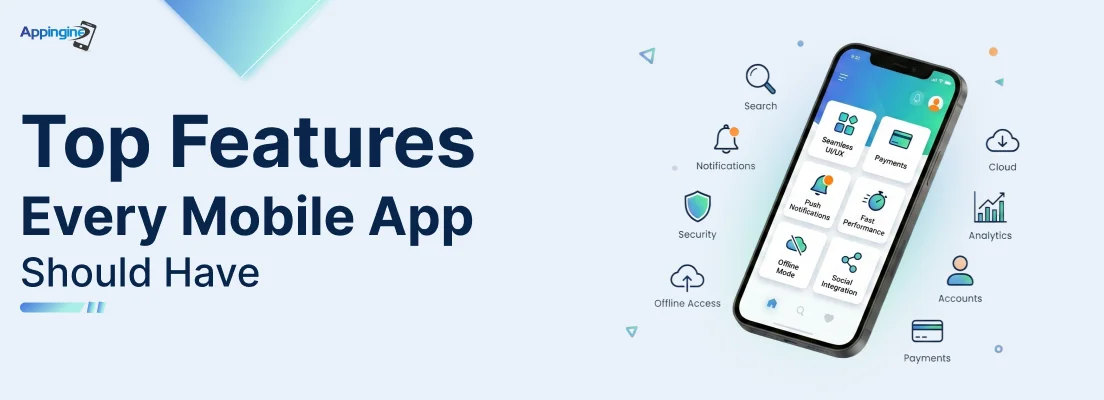
On a platform with a million apps competing for a spot on mobile home screens, the difference between a loyal user and an instant uninstall often comes down to a handful of core mobile features, if done right. According to the studies, it shows that 88% of users abandon an app after a single bad experience. This means there is no chance for the product team and developers to do anything wrong.
Now, the real question that pops into the heads of every stakeholder related to the mobile app development process is what exactly makes a great mobile app an unforgettable one?
The mobile features incorporated in the app truly elevate it beyond the obvious. Accessibility features like Robust fonts and screen reader support open the door to over a billion users. And above all, the performance of the app is the silent foundation. Why? Because no matter how innovatively your app is designed or clever the feature set are, a slow app is a dead app.
In this blog, we'll discuss key mobile app features that will help you understand what people actually anticipate, whether you're starting from scratch or improving an existing one.
In order to prevent using out-of-date percentage-based statements, statistics and claims have been updated. Now, "Single Sign-On" is referred to as "Authentication & Identity," which includes enterprise identity providers and passkeys.
Mobile app store privacy regulations and contemporary compliance standards are increasingly included in security coverage.
Trust and safety criteria are now included in chat and user-generated material.
Core baseline features and optional growth features are now separated by feature prioritization.
How our developers focus on creating enterprise-grade applications and what services we employ so your application stays ahead of the competitors in the digital market. Followed by that, let’s explore the list of some of the exceptional features that will take your application to the next level.

An interface that is easy to use is still essential. No matter how many sophisticated app features you offer, user retention declines if they are unable to finish high-value tasks fast.
Clear navigation, consistent interaction patterns, touch-friendly controls, and first-rate accessibility are all indicators of UX quality in 2026.
When used properly, push continues to be a powerful function. The success of notifications increasingly hinges on user control, relevancy, and consent.
Notifications should be viewed as a product surface rather than a broadcast channel. Permit users to select quiet hours, topics, and frequency.
Field teams, travel use cases, and unreliable networks continue to require offline support. Users anticipate that important tasks will function even in the event of poor or nonexistent connectivity.
Local caching, background syncing, dispute resolution, and unambiguous status indications are all components of a contemporary offline strategy.
For enterprise rollouts in particular, traditional SSO is still crucial. Teams should assess passwordless flows and passkeys in 2026 as well.
Faster sign-in, fewer support issues, and improved account security without adding complexity are the straightforward objectives.
There is no feature toggle for security. It is both a platform and a trust requirement.
Teams should, at the very least, prepare for role-based access, auditability, encrypted transmission, secure storage, secure authentication, and transparent data handling procedures. Regulations like GDPR and certifications like ISO 27001 are still crucial for many businesses.
Although they are not always necessary, polls are nonetheless helpful for rapid sentiment checks and participation.
When lightweight input loops from staff, members, or communities are required, use them.
Because consumers need a uniform experience across iOS, Android, and the web, cross-platform distribution continues to be a key differentiation.
Maintaining a single core experience and making necessary adjustments is more effective for most teams than overseeing several disparate offerings.
You can publish a single app experience for mobile, tablet, and online platforms with Appingine.
In the appropriate setting, gamification is still effective, particularly for community involvement, learning, and onboarding.
It shouldn't interfere with essential workflows; rather, it should promote significant results. Ignore points and badges if they don't support user objectives.
You can customize the gamification app features in Appingine's communication solution for your target audience.
Now more than ever, this is crucial. Teams must respond to platform changes, deliver enhancements fast, and resolve problems without lengthy release cycles.These days, "easy to update" refers to maintainable architecture, effective content changes, transparent release procedures, and rigorous testing.
Chat is still essential for assistance and teamwork. Service-level expectations, moderation controls, and escalation flows are all part of the quality bar in 2026.
The finest conversation experiences blend governance and speed.
Investigate Appingine's Communication solution if you want to improve teamwork and communication.
One of the best retention strategies is still personalization, but it needs to be transparent and considerate of privacy.
Prioritize practical personalization, such as contextual recommendations, suitable information ordering, and role-based dashboards. Not only this, but our custom app developers take advantage of the latest technologies and tools to give your idea a new shape and fit perfectly with the market needs and trends.
Also, go through: Intelligent Custom Apps Powered By Appingine

Global adoption still depends on localization, but effective localization now involves more than just text translation.
Workflows, dates, formats, legal content, and important support resources should all be localized by teams.
Appingine's multilingual features facilitate the delivery of a single app in several languages for businesses that are growing internationally.
UGC can drive engagement and community value, but it comes with operational responsibility.
If users can post content, plan moderation workflows, reporting, abuse handling, and clear content policies before launch.
For idea capture and collaborative innovation use cases, Appingine's Innovation Management solution helps teams collect and prioritize user contributions.
One of the app features with the highest return on investment is still feedback. The speed of response is the crucial change.
Utilize brief in-app feedback loops, promptly resolve problems, and notify users when changes are made.
Applications with a lot of material and process still rely heavily on search.
In 2026, a great search will include filters, relevance ranking, typo tolerance, and helpful zero-result advice.
Features like filters and bookmarks are still crucial for task continuity and discoverability.
These "simple" features enable users with varying degrees of technical confidence, minimize effort, and enhance repeat usage.
As user expectations continue to evolve, building a successful mobile app requires more than just innovative ideas—it demands a strong foundation of usability, security, performance, and trust. By prioritizing essential mobile app features such as intuitive design, robust authentication, personalization, offline access, and effective user feedback mechanisms, businesses can create experiences that drive engagement, retention, and long-term growth. The most successful apps are not those with the most app features, but those that consistently deliver value, reliability, and a seamless user experience.

Tel: +1 (800) 453-1297
Email: [email protected]
Main Office:
4929 Wilshire Blvd, Los Angeles, CA 90010
© 2026 Appingine. All Rights Reserved.