Appingine
Let's Discuss Your Tech Solutions

Camilla Lawrance

 02/04/2026
Launching a startup or planning your next mobile application? In this rapidly shifting tech landscape, choosing the right development framework can make or break your product's success. With mobile app failures at an all-time high, often due to poor platform choices and development strategies, understanding current trends isn't just helpful, it's essential.
Flutter has emerged as the go-to cross-platform framework for modern app development, offering unparalleled speed, cost efficiency, and native-like performance across iOS, Android, web, and desktop. As we move through 2026, Flutter continues to evolve with game-changing features that are reshaping how developers build applications. Whether you're a startup founder, product manager, or developer looking to stay ahead of the curve, understanding these emerging Flutter trends will help you make informed decisions and build apps that truly stand out in a crowded marketplace. Still not sure if flutter is worth it, then you should read this guide: pros and cons of developing an app with flutter.
As we already know, flutter is an open-source UI software development kit which was introduced by Google. It has quickly grown in the digital market due to its ability to create cross-platform apps without compromising the quality and being cost effective. It has a robust engine, rendering capabilities, APIs for testing and integration, and the intuitiveness of user-friendly widgets that make app development simple from the beginning.
It is hands down the best choice for businesses of all sizes, and more businesses can take advantage of the maximum features and functionalities of the Flutter capabilities without breaking the bank. How is that possible? Well, there is a list of statistics of multiple businesses in the market, reaching up to 2 million users.
Partner with Appingine to create high-performance, cross-platform apps that engage users and drive business growth.
Build Your Flutter App!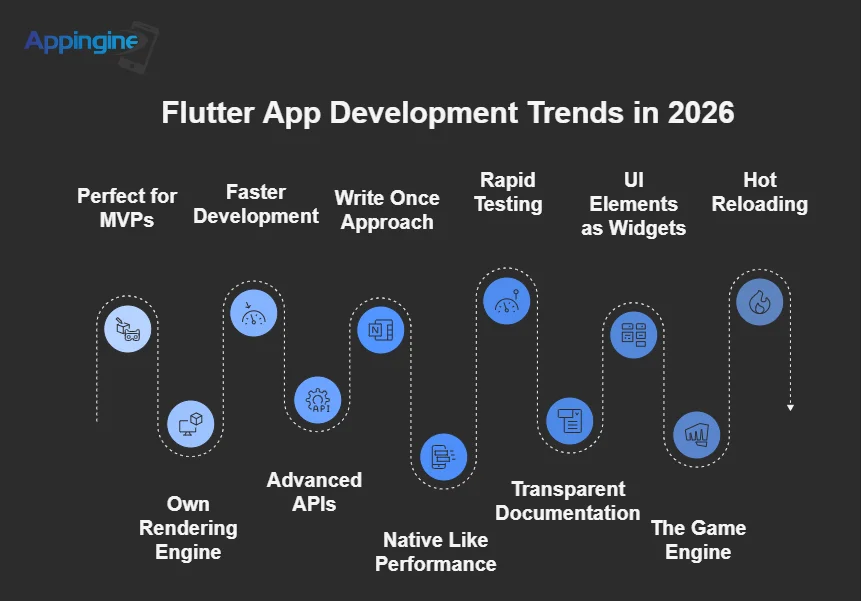
Since its first release, Flutter has turned the digital world upside down with every new upgrade. The platform becomes smoother and adaptable, which allows developers to build incredibly engaging apps with exceptional performance and match the market quality standards of the application. Flutter is expected to establish itself as a leading trend in the market by becoming the preferred cross-platform framework for app development.
Let's see what these ongoing market trends are:Validation is the key to startup success. To minimize risk and resource spend, many organizations turn to MVPs built with Flutter. It allows developers to ship essential features quickly, providing a low-stakes environment to test and refine business ideas.
Because Flutter uses a single codebase for both iOS and Android, there is no need to maintain two separate development tracks. This efficiency slashes time-to-market and reduces overhead, letting you focus your energy on growth rather than rewriting code.
As mobile development accelerates, businesses are prioritizing high-performance rendering to drive user engagement while slashing costs. Flutter leads this evolution with its next-generation rendering engine, Impeller. By pre-compiling shaders, Impeller eliminates the common "startup stutters" found in other frameworks, ensuring your app delivers silky-smooth animations from the very first frame.
Unlike traditional frameworks that rely on platform-native buttons, Flutter’s built-in engine draws every pixel directly. This gives you complete creative freedom and near-native speeds on both iOS and Android using a single codebase.
One of the most common barriers that developers usually face are code complexity, challenging debugging, complicated UI/UX, and app security which can be easily overcome by using Flutter.
With Flutter, developers are now using a single codebase and its hot reload feature to significantly reduce testing time and simplify the development process. Its efficient and straightforward process allows developers to avoid complicated programming infrastructures and deliver apps faster and impress clients.
For startups, Flutter not only saves time but is more focused on strategic planning and future business goals, which lets you concentrate on the big picture rather than the fundamentals of coding.
Poor user experience is the silent killer of many promising applications. In 2026, where users demand instant responses and fluid motion, Flutter has become the industry standard for overcoming these hurdles. By natively supporting advanced HTTP and RESTful architectures, Flutter ensures your app stays connected to the world with high-speed data exchange and real-time updates.
Beyond just a "smooth build," Flutter empowers developers to create dynamic, interactive features that define a reputable brand. Its deep integration with backend resources simplifies the implementation of sophisticated animations and complex transitions. This results in a polished, premium feel that not only satisfies users but fosters the long-term loyalty required for skyrocketing market success.
Is Flutter popular? It is the definitive framework that empowers developers to create a single codebase that operates flawlessly across iOS, Android, and beyond. In a crowded market, Flutter stands out by not only saving time but drastically reducing the effort and resources required to maintain a consistent, high-tier user experience.
By embracing the "Write Once" philosophy, developers unlock a suite of strategic business advantages that native development simply cannot match. Key benefits include:
Flutter uses an Ahead-Of-Time compiler along with the Dart programming language to provide a real native-like experience as compared to many cross-platform frameworks. This makes it possible to compile the app code and run it directly on the device while improving performance, facilitating smoother interactions and making the user experience more engaging
Using Flutter for mobile app development reduces testing efforts significantly because there is only a single codebase to manage. Since the same code runs across multiple platforms, developers don’t need to test separate versions for each platform. Additionally, Flutter supports automated testing while streamlining the testing process and ensuring consistent performance across different platforms.
There are three types of testing in Flutter:
Flutter’s global community is expanding at an unprecedented rate, cementing its status as the premier technology for the future. It is not merely a trending framework; it provides exceptionally clear, well-structured, and transparent documentation that empowers developers to master the architecture instantly and deploy high-performance applications with total confidence.
Highly customizable widgets are a cornerstone of Flutter’s popularity, empowering developers to craft immersive, interactive user interfaces with precision. These pre-built components update dynamically in real-time, streamlining both initial development and long-term maintenance while maximizing operational efficiency.
Beyond the extensive library of free tools, every widget can be tailored to meet exact brand specifications, granting developers total creative freedom to build bespoke elements from scratch.
Because Flutter’s architecture prioritizes reusability, a single component can be deployed across multiple screens. This modular approach drastically slashes development timelines while guaranteeing a flawless, consistent user experience throughout the entire digital ecosystem.
Flutter’s popularity in the gaming industry has been booming since the release of Flame which is a lightweight and composable game engine that makes it simple for developers to create captivating games.
Flame is based on Flutter's framework that streamlines code structure along with offering an effective game loop and all necessary features and functionalities for game development. It also comes with input handling, image rendering, sprite sheets, animations, collision detection, and a versatile component system. Because of this, Flame is the best option for using Flutter to create high-performance 2D games.
To extend its capabilities, Flame offers a list of stand-alone packages, which are:
By offering industry-leading features like Hot Reload and Hot Restart, Flutter has become the premier choice for modern mobile development. But what makes these tools so essential? They allow developers to inject code changes instantly often in under one second, without losing the app's current state. This means your team can refine UI elements and fix bugs hand-in-hand with the live application, ensuring an extraordinary level of precision and speed.
The timeline for developing a Flutter application is influenced by several variables, including project complexity, feature sets, UI/UX depth, and backend integration requirements. Generally, a basic Flutter app featuring core functionalities can be brought to market in approximately 2 to 5 weeks. For medium & high-complexity projects that require more advanced features and third-party integrations, the timeline typically extends accordingly. Here’s the full breakdown:
| App Type | Time Frame |
|---|---|
| Basic Flutter App | 2–5 weeks |
| Medium Complexity App | 8–14 weeks |
| Advanced Flutter App | 12–20+ weeks |
Flutter is adopted by the top companies globally, such as BMW, Toyota, The New York Times, eBay, Alibaba, Tencent and more to build seamless mobile and web applications. These real-world examples highlight how leading brands take advantage of flutter’s capabilities for cross-platform, rich UI as well as scalability to deliver consistent and engaging user experiences across multiple devices.
Toyota uses Flutter to enhance the In-car entertainment system in its vehicles by taking full advantage of the high performance and rich UI capabilities that align by having a reputable place in the market for reliability and premium design. By building its Linux-based In-car entertainment system with Flutter, Toyota has created a smooth along with visually appealing experience while enabling continuous user feedback as a result improved functionality and a more connected driving experience.
In 2018, when eBay Motors, a marketplace for buying and selling vehicles and auto parts, set out to develop new iOS and Android apps that mirrored the main eBay.com experience, the development team chose Flutter due to its growing popularity. Using Flutter, they were able to create an impressive app while sharing 98.3% of their codebase across business logic, domain models, analytics, UI, and network stack. An internal survey also revealed that 70% of their developers found Flutter’s deployment speed to be twice as fast as native solutions.
At Appingine, our Flutter app developers not only bring deep technical expertise but also help you turn creative ideas into high-performing digital products. Moreover, our team carefully evaluates your project goals, timelines and technical requirements while gathering requirements in the beginning to recommend Flutter where it adds the most value. We ensure to take full benefits of flutter’s single codebase approach, native-like performance and flexible UI capabilities to deliver cost-effective solutions without compromising on the quality.
The best part about us? Our hands-on approach and proven understanding of Flutter’s ecosystem, Dart architecture, and platform integrations. Furthermore, we focus on building secure, visually engaging and future-ready apps that align with your business growth strategy.
Give us a call and discuss your Flutter app idea for absolutely no cost at all!
Build Your Flutter App!In conclusion, Flutter has emerged as a game-changing framework in the mobile app development landscape, offering businesses and developers a cost-effective, high-performance, and versatile solution for building cross-platform applications. With its single codebase approach, native-like performance, customizable widgets, advanced APIs, and rapid development capabilities, Flutter not only streamlines the app development process but also ensures an engaging and seamless user experience across multiple platforms.
Supported by a growing global community, robust documentation, and innovative tools like the Flame game engine and hot reload, Flutter continues to set new trends in 2026 and beyond. Leading brands such as Toyota, eBay, BMW, and Tencent have already leveraged Flutter to deliver scalable, visually appealing, and high-performing applications, demonstrating its reliability and strategic value. Partnering with our experts, ensures that businesses can fully harness Flutter’s capabilities to create future-ready, secure, and impactful digital products while saving time, resources, and costs.
Flutter continues to dominate in 2026 due to its single codebase approach, native-like performance, customizable widgets, and faster development cycle. With strong support from Google, an expanding global community, and continuous updates, Flutter enables businesses to build scalable, high-performance apps efficiently across multiple platforms.
Key Flutter trends in 2026 include MVP-first development, advanced API integrations, native-like performance with Dart AOT compilation, hot reloading for rapid testing, UI-first development with reusable widgets, and the growing use of Flutter in game development through the Flame engine.
Yes, Flutter is highly cost-effective because it allows developers to write one codebase for multiple platforms like Android, iOS, web, and desktop. This significantly reduces development time, testing efforts, and long-term maintenance costs compared to native app development.
Absolutely. Flutter uses its own high-performance rendering engine (Skia) and Dart’s Ahead-Of-Time compilation to provide smooth animations, fast load times, and responsive interactions, resulting in a truly native-like user experience across devices.
Appingine stands out for its expert Flutter developers, strategic project planning, and deep understanding of Flutter’s ecosystem. The team focuses on delivering secure, scalable, and visually engaging applications that align with business goals while leveraging the latest Flutter trends for long-term success.

Tel: +1 (800) 453-1297
Email: [email protected]
Main Office:
4929 Wilshire Blvd, Los Angeles, CA 90010
© 2026 Appingine. All Rights Reserved.