Appingine
Let's Discuss Your Tech Solutions

Camilla Lawrance

 01/01/2026
Making an informed choice for the app development project is very important, and the decision should be made at the very early stage, the planning stage. Many of the mobile app developers get queries about which tech stack is suitable for the client's project, which is suggested after an overview of the needs and requirements of the project.
Mostly, many app developers in Houston hop on Flutter as their desired framework. But the question is why? Well, Flutter is not just the most dynamically evolving framework but it is also an exceptional pick for cross-platform applications. If you are curious to learn about whether flutter is good or not, and why to choose it for your app development project, read this blog till the end and absorb every drop of knowledge.
If you have an app idea ready to be built on Flutter then click the button below and talk with us now!
Develop Your App On FlutterTo create quality applications for multiple platforms such as web, mobile applications, and more, an open-source Flutter UI framework was launched by Google that developers can easily get their hands on a single codebase. Flutter is useful for making beautiful cross-platform apps that run native code on all platforms and operating systems. Not only that, there is no doubt about the compatibility of Flutter with several platforms and their operating systems such as Android, iOS, Linux, macOS, Windows and many more in the competitive market.
The foundation of Flutter is Dart, which is an object-oriented programming language that forms the basis of Flutter. It directly complies with both native code for desktop and mobile platforms and JavaScript. Dart creates an invisible communication bridge with a platform and allows for the assurance of outstanding app performance.
If we go through the market survey, it is noticed that the software development industry is ruled by Flutter, which is known to be the most popular among development teams.
In 2025, it was demonstrated that 46% of developers took advantage of Flutter for cross-platform app development.
Flutter's popularity has encouraged enterprises like Whirlpool, Virgin Money and Universal Studios to use it as well, as evidenced by the high-performance and secure apps from corporations like Credit Agricole, BMW, Toyota, and Tencent.
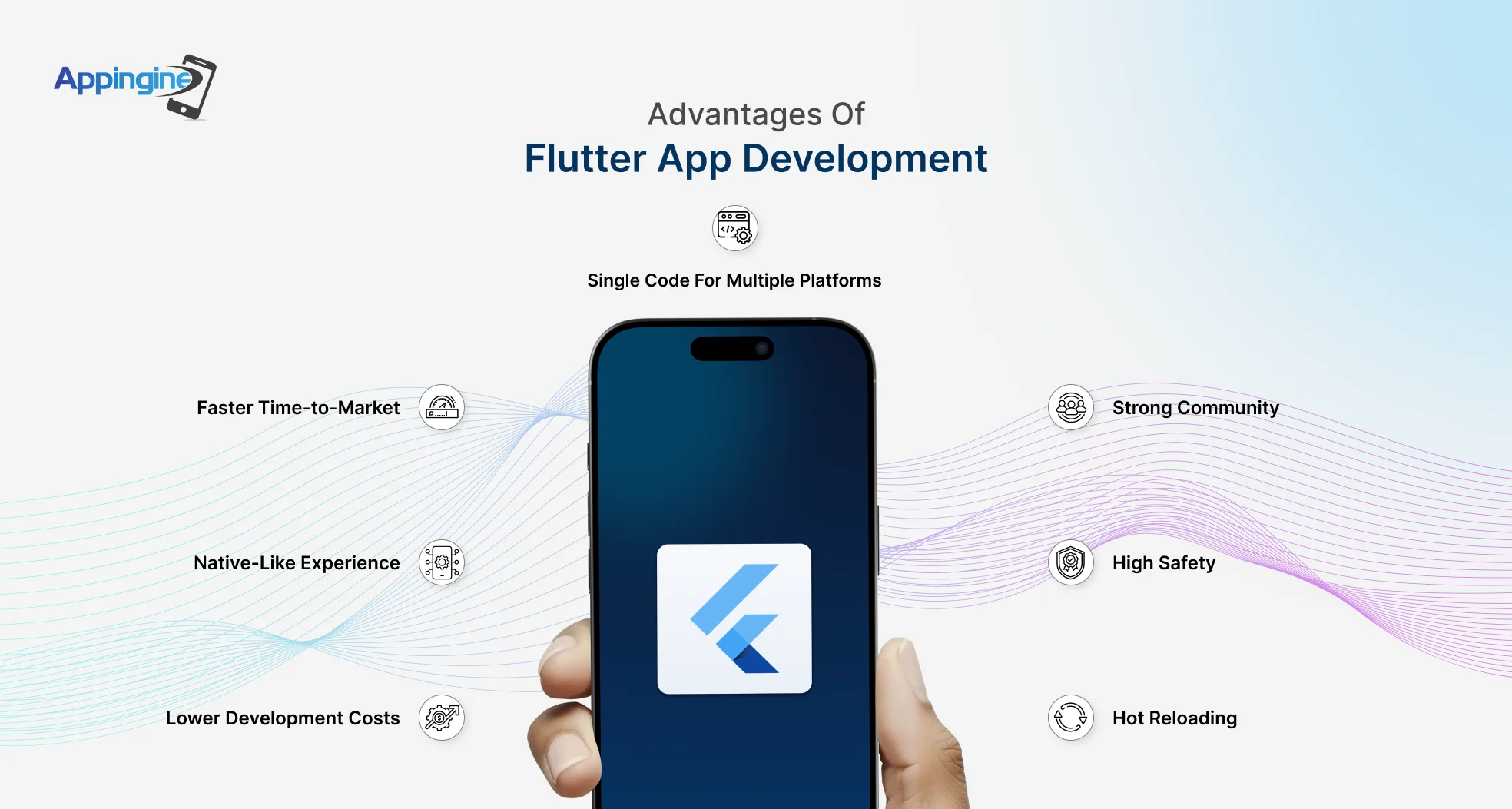
Here are some of the pros of developing a mobile app on Flutter:
Flutter permits developers to write code once and reuse it to deliver applications for multiple platforms, which include desktop, web, and mobile.
The time usually needed to write code bases for different apps is decreased by cross-platform app development.
No intermediary code representations or interpreters that impact software performance are used by Flutter. Rather, it utilizes a graphic engine called Skia to guarantee seamless, native-like cross-platform app performance.
The aforementioned benefit is strongly linked to this one. Preparing a single code base and using it for multiple app versions is less expensive.
Developers can always locate someone who can assist them in resolving problems or determining the best method for creating different Flutter applications. Businesses can benefit from this trend since it makes it easier to locate Flutter developers.
At the syntactic level, safety is already guaranteed. Flutter uses single-threaded UI programming. Computational threads are executed in separate sandboxes. This method aids in getting rid of shared or dangerous resources that might lead to more vulnerabilities.
Developers may instantly view all changes made to the app's code thanks to this highly appreciated functionality. This reduces the amount of time required to address errors and allows development teams to test new concepts without wasting too much time on experiments.
Though the benefits of flutter make the app development project innovative, and work smoothly. But when there are pros, there come cons as well.
Since the technology is still comparatively fresh, some parts have not yet been properly adapted to developers' needs, which could be classified as disadvantages of flutter.
Although Flutter apps generally function well across several platforms, Android offers some clear benefits. This is a fairly straightforward explanation: Google is the creator of Flutter. Because of this, there may be some problems with Flutter-built apps on iOS devices.
Compared to many other frameworks, Flutter developers have fewer opportunities to rely on external libraries.
For Flutter app developers, Dart's nature offers numerous advantages. However, the developers must acknowledge that this language is still not very popular. But when compared to C#, Java, or JavaScript, few fresh engineers choose Dart as their first programming language.
Why is this so? Because it is difficult in some particular situations to get professionals who are proficient in this language and can create your program according to your specifications.
Hire our Flutter app developers to build seamless and powerful cross-platform apps that perform well in the market.
Get A Free QuoteThere are two key components of Flutter:
| SDK (Software Development Kit) | Framework |
|---|---|
|
A set of instruments that serves as an aid in the development of an application Includes tools for converting code to native machine code Works on code for iOS and Android |
Set of reusable user interface components These are customizable according to the purpose Components include buttons, text inputs, sliders, etc. |
Google uses Flutter across both internally as well as externally developed products that are facing. The internal products include Google Ads, Google Pay, Google Classroom, and YouTube Create, to deliver fast and consistent experiences throughout the world. By relying on Flutter for applications that are user-facing and investing in dedicated internal Flutter teams in NY that ship new products By releasing multiple platforms in the market for itself, Google has demonstrated that Flutter is a scalable and enterprise-ready tool.
Now if you are still wondering how a single-codebase app development framework can be the best pick by the top mobile app development companies? Well, it has been noted that just 30% of businesses utilize Flutter exclusively for iOS and Android, despite the fact that it has been developed as the preferred solution for mobile app development. Flutter is used by more than 95% of respondents for both iOS and Android mobile operating systems, 64.4% for web applications, and many for desktop applications (macOS 24.1%, Windows 20.1%, and Linux 11.2%).
By considering these numbers, we can have a better view of the rise of Flutter app development in the competitive landscape. And if you are running a business or are willing to step into the digital world, then go through some examples of how Flutter can be the best choice for business scale-ups.

Developing an application using the latest tools, such as Flutter, is easy and an ideal choice for small applications with fewer features and functionalities. Why? Because it enables quick application development and inexpensive end-product delivery. However, let's examine framework usability by having a detailed overview of some of the use cases.
Mindy is a mindfulness app built to deliver a calm user experience. Flutter is chosen for the mobile development and .NET Core for the backend, which helps in enabling an intuitive interface. Flutter made it easy to implement a scalable subscription-based model through seamless integration with native SDKs for cross-platform Apple Pay and Google Pay. Impressively, the first phase of the app was successfully delivered during a summer internship program while proving Flutter to be both powerful and highly efficient.
An app that assesses the mental health of workers. This Hamburg-based German scaleup offers a sophisticated HR solution that enables user self-testing and personal monitoring. When creating a Design System built on an intricate collection of reusable forms and inputs to carry out different tests and questions, Flutter proved to be incredibly effective. This project is another illustration of how the client's young in-house engineers are learning Flutter while working with LeanCode's team to produce new features.
A Polish well-being app is designed to boost employee engagement through custom sports challenges. Activy, recently shifted completely from React Native to Flutter. While earlier versions relied on React Native with native elements like activity tracking and Redux for state management, Flutter brought a transformative upgrade such as high performance, fluid animations and smoother app responsiveness. The result? A more seamless, engaging, and satisfying experience for users, making staying active at work both fun and effortless.
With industry leaders like BMW, LG, Universal Studios, Headspace, Viessmann, Bayer, Sonova, Whirlpool, Xiaomi, eBay Motors, and Geico proving that Flutter can power complex, high-performance, and security-tested applications at scale, the number of solid, real-world case studies showcasing Flutter in large-scale and enterprise environments keeps growing. MASPEX POSme, a Flutter-based solution created to optimize marketing operations for MASPEX, a prominent FMCG company in Poland that handles hundreds of POS materials every day across national retail stores, is one noteworthy enterprise example.
While Flutter allowed for quick MVP development and a quicker time-to-market for future improvements, demonstrating its suitability for creating reliable, scalable enterprise applications, POSme helped the company successfully address major logistical challenges related to planning, production and distribution while resulting in significant time savings, improved user experience, and decreased errors in material distribution.
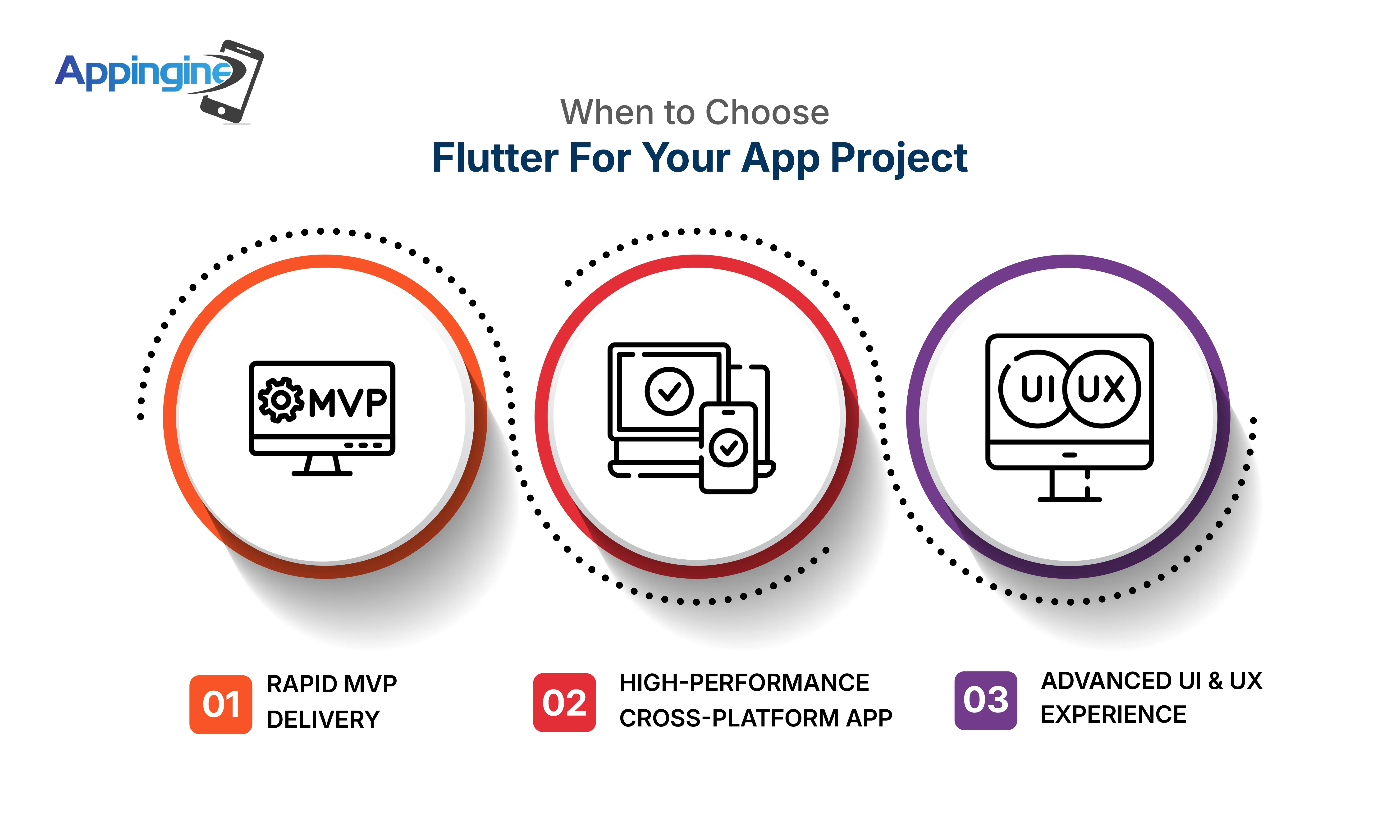
Flutter app development comes with both advantages and limitations, but their impact largely depends on your project’s specific goals, constraints, and external factors. Moreover, there are some cases where Flutter’s drawbacks may become more noticeable and create difficulties; however, there are also clear use cases where Flutter stands out as an excellent choice while making it important to understand when this framework truly fits your app strategy.
As previously said, developers can create solutions using Flutter far more quickly than with any other SDK, including cross-platform ones. The building tool that is supplied and the many widgets that development teams have access to make this possible. Coding, testing, and bug fixes are all significant project realization phases that are expedited and simplified, which is quite helpful when there are tight deadlines. Because of this, Flutter frequently ends up being the best option for a minimal viable product.
You've probably heard that native apps usually outperform cross-platform apps. However, the speed, dependability, and smooth operation of Flutter apps set them apart from the others for cross-platform app development.
The ability to control every pixel of the application's interface is made possible by Flutter. This allows you to design stunning user interfaces with a variety of components that won't negatively impact your solution's performance. For situations where you have certain UI & UX designing needs, Flutter app development makes sense.
Not everyone is aware of the technologies and tools that are utilized while developing an application of today. And this makes it even more impressive that globally popular and high-performing applications are built using this cross-platform SDK by taking care of the needs to be fulfilled of the app being scalable and compatible enough to be run in several devices.
The Flutter app engineers have reported measurable productivity gains, with the Google Pay team, while reducing efforts by 70% and cutting required lines of code by 35%. The eBay Motors development team shared equally strong results by noting that 100% of their developers enjoyed working with Flutter more than native iOS or Android development.
Such results show the efficiency of Flutter in different projects while having a clear understanding of the business's goals, contents and developers' skills requirements.
Our Flutter app team not only brings deep technical expertise for your product but also helps brands & SMBs turn ideas into high-performing digital products. Our team carefully evaluates your project goals, timelines and technical requirements in the beginning to recommend Flutter where it adds the most value. The developers ensure to take full advantage of flutter’s single codebase, native-like performance, and flexible UI capabilities to deliver cost-effective solutions without compromising on the quality.
The best part about Appingine is our hands-on approach and proven understanding of Flutter’s ecosystem, Dart architecture, and platform integrations. Furthermore, the experts focus on building secure, visually engaging and future-ready apps that align with your business growth strategy. Whether you’re an enterprise aiming for scalability and consistency across multiple platforms, Appingine ensures your Flutter app is built in such a unique way that leads to long-term success.
Choosing the right technology stack in the early stage of development is a plus that can define the long-term success of your app and Flutter has proven itself as a powerful and reliable framework for businesses of all sizes. Flutter’s single codebase, native-like experience and cross-platform flexibility make it a strategic choice in today’s competitive digital landscape. When you choose to work with the right development partner like Appingine, that is when you gain more than just an app, you automatically sign up for a scalable digital solution that is built to evolve, perform and succeed in the long run.
Explore our Flutter app expertise and start building your apps without any restrictions or limits.
Get EstimatesFlutter is an open-source UI framework by Google that allows developers to create cross-platform apps from a single codebase. Its popularity comes from fast development, native-like performance, flexible UI design, and cost efficiency.
Flutter supports Android, iOS, web, macOS, Windows, and Linux, allowing businesses to reach multiple platforms without maintaining separate codebases.
Yes. Companies like BMW, Universal Studios, and Google Pay have used Flutter for complex, high-performance, and scalable enterprise apps, proving its reliability for large-scale projects.
Flutter is ideal for cross-platform apps, rapid MVP development, apps requiring advanced UI designs, and projects needing cost-effective, scalable solutions across multiple platforms.

Tel: +1 (800) 453-1297
Email: [email protected]
Main Office:
4929 Wilshire Blvd, Los Angeles, CA 90010
© 2026 Appingine. All Rights Reserved.