Appingine
Let's Discuss Your Tech Solutions

Camilla Lawrance

 03/05/2026
Due to the rise of technology and the usage of smartphones and devices, the digital world is transforming rapidly. One of the most prominent factors that affects the consumption of the latest technologies is the increasing market and user demands, and most of all, security.
In order to meet these evolving market demands and user requirements, developers and businesses are increasingly turning to cloud-based backend solutions. That’s where mobile backend as a service (MBaaS) comes into play.
Now, what is a mobile backend as a service? Mobile Backend as a Service (MBaaS) is often also referred to as cloud backend as a service or CBaaS which is hosted by the cloud to handle functionalities like Databases, Authentication & user management, APIs, Cloud functions / serverless logic, File storage, Scalability & auto-scaling, and infrastructure management of the platform. Furthermore, it’s designed to support any type of application, whether web apps, mobile apps, desktop apps, IoT, or even internal business tools.
When we talk about businesses, many are still managing behind the scenes. But now the world demands speed, flexibility and reliability without compromising the quality. And most importantly, for the app's success, BaaS steps in to quietly handle heavy lifting while teams focus on innovation, user experience and growth, which actually drives value to the business.
MBaaS is often used alternately with Backend as a Service (BaaS), though there are slight distinctions between the two. BaaS is generally more associated with web-based applications and may offer greater storage capacity to support larger web apps, while still being capable of serving both web and mobile environments.
MBaaS, on the other hand, refers to the “mobile” label but is not limited to mobile app development; modern MBaaS platforms can support web, desktop, tablet, and mobile applications alike. For example, platforms like Backendless provide robust cross-platform capabilities while enabling businesses to build and manage applications seamlessly across multiple device types using a single backend.
Let's have a look at the table below, so no confusion remains rent-free in the head:
| Aspects | MBaaS | BaaS |
|---|---|---|
| Primary Focus | Mobile-first application development | Web-first and general application development |
| Typical Use Cases | Mobile apps (iOS, Android) | Web apps, enterprise systems, SaaS platforms |
| Platform Support | Mobile, tablet, web, and desktop | Web, mobile, desktop, and IoT |
| Core Features | Authentication, databases, APIs, cloud functions | Authentication, databases, APIs, cloud functions |
| Mobile-Specific Features | Push notifications, offline sync, mobile SDKs | Usually limited or optional |
| Storage Capabilities | Optimized for mobile app data | Often offers larger storage for web-heavy apps |
| SDK Availability | Strong SDK support for mobile platforms | SDKs focused more on web and backend |
| Scalability | Scales with mobile user growth | Scales with web traffic and data-heavy workloads |
| Flexibility | Slightly opinionated toward mobile workflows | More flexible for complex backend logic |
| Modern Trend | Evolving into full Cloud BaaS platforms | Broader umbrella that includes MBaaS |
Reduce development time and costs while ensuring your apps remain secure, scalable and high-performing. Hire us!
Get Started with App DevelopmentThe most common set of capabilities provided by an mBaaS are:
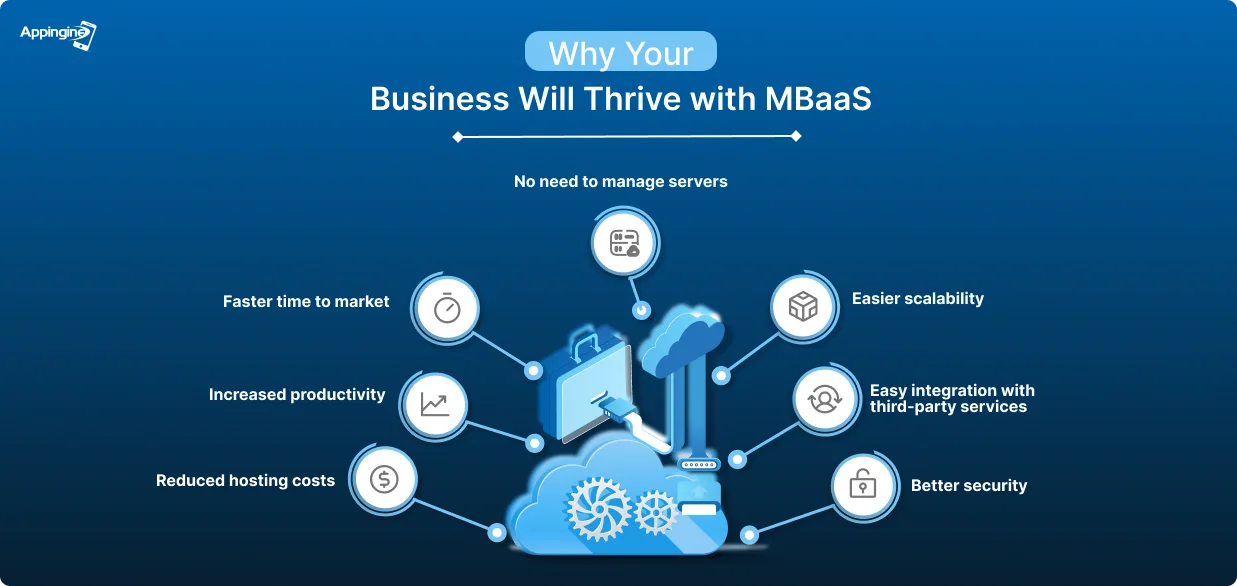
There is a list of benefits that BaaS offers, some of which are listed below.
With an MBaaS platform, all the headaches of managing backend servers for mobile apps, security updates, backups, scaling, & performance tweaks disappear. If you are a developer, then with MBaaS, you can focus entirely on building an amazing frontend experience, and let the platform take care of the backend.
Building a mobile application from scratch has become easier with a hassle-free launch by taking advantage of the MBaaS platform. All you have to do is handle the design phase so you provide a remarkable user interface, reduce the app development timelines and significantly cut down the costs. This helps your ideas reach users faster and more efficiently.
An MBaaS platform gives you an open ground to let you create exceptional apps that delight users and drive your business forward. while freeing you from the headaches of backend functionalities.
With a mobile backend as a service, there’s no need to spend on costly hosting or maintenance. You only pay for the resources your app actually uses by making development smarter, simpler and more cost-efficient.
An MBaaS platform makes scaling effortless by simply making it adjustable according to your app’s demand. You don’t need to worry about infrastructure planning or server allocation.
Many MBaaS platforms make it easy to connect with popular third-party services like Facebook, Twitter, and Slack. This means you can integrate essential features seamlessly, without duplicating functionality across multiple systems.
An MBaaS platform takes care of your data by automatically encrypting sensitive information both in transit and at rest. MBaaS offers built-in security that handles users’ data efficiently and keeps them protected.
Let Appingine’s managed cloud infrastructure handle authentication, databases, and infrastructure so your team can innovate.
Book a Free ConsultationNow that we’ve covered the overall benefits, let’s take a closer look at how an MBaaS platform handles critical backend functions.
When it comes to managing the infrastructure of the application on your own, it could be costly, time-consuming and inefficient, especially for apps with fluctuating usage that may require constant adjustments.
With an MBaaS platform like Backendless, all of that heavy lifting is taken care of for you. From server management to scaling, security, and performance optimization, the platform handles the entire backend.
Today, building an application for developers has become easier than ever. An MBaaS solution that typically provides pre-built and cloud-hosted components that developers take advantage of to build apps quickly. The MBaaS solution not only saves time but also effort since these components are already tested and functional.
How could an MBaaS platform be suitable for businesses? Many business owners keep these capabilities up to date by helping reduce time to market for new app versions. Because much of the app’s development elements and business logic may reside within the platform, enterprises can become tied to a specific vendor while making it costly and challenging to switch providers later.
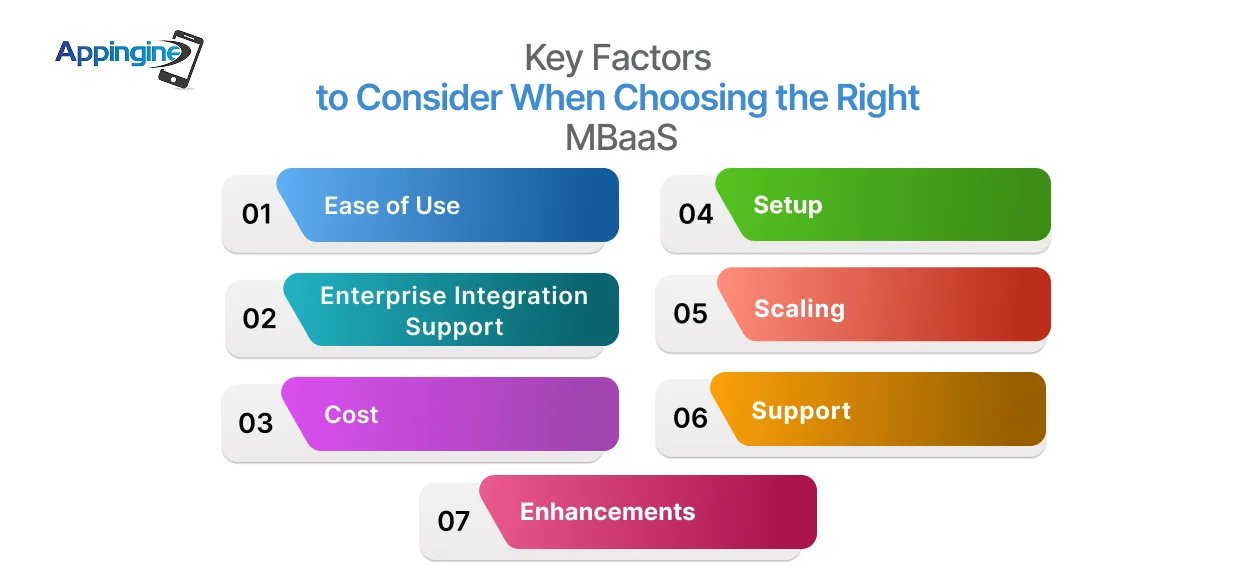
From a business perspective, the key factors to be considered while adopting an mBaaS in an enterprise are:
The rise of MBaaS was driven by the demand for a simpler way to build cross-platform applications. Because of this platform, ease of use plays a major role in the success of an MBaaS platform's adoption.
Since apps need to connect with internal business and IT systems, seamless integration is critical. But with the best MBaaS platforms, the process seems easier through well-designed APIs and web services, rather than requiring custom-built backend applications.
Investing in an MBaaS platform should be justified by the real value and capabilities it delivers. Since adopting an MBaaS can also mean committing to a long-term vendor relationship. It’s essential to carefully evaluate providers upfront by choosing one that aligns with your technical needs, budget and future growth plans.
The MBaaS platform gives a clear picture of how quick and easy it is to set up and put into action.
As the requirement changes over time, the backend should be smart enough to scale up or down seamlessly by making sure an optimal performance of the app solution while making the most efficient use.
By being dependent on the type of applications that you are building, strong service-level agreements (SLAs) and responsive support can be critical to ensuring performance, stability, and business continuity, but not with MBaaS.
A vendor’s product roadmap and desire to deliver custom enhancements can make all the difference in choosing the right MBaaS solution. The best platforms evolve alongside your business by adapting to your enterprise needs, rather than forcing your processes to adopt the advanced technology.
From a technical perspective, here are some of the factors which are influenced by your MBaaS solution.
Who doesn’t like to stay connected, whether online or offline, and work without interruption, and that's what has been taken care of by adopting MBaas service. Making the work flow easier for the critical application that can’t afford downtime, data access must be available at all times.
Storing too much data on the device can eat up precious space, but not anymore. While fetching everything from the backend server for mobile apps or any other platforms can quickly consume bandwidth. The sweet spot? Cache only the most relevant data locally and let your mBaaS handle automatic backups so users always have everything with them stored and accessible, anytime, anywhere.
An enterprise integration framework should do more than just connect systems; it needs to be ready for continuous changes across your IT landscape and push relevant updates directly to mobile devices as notifications. What does it do? This ensures data stays synchronized in real time effortlessly.
Keeping data in sync across multiple devices is essential, any change on one device should instantly reflect on all others tied to the same data.
The mBaaS should seamlessly integrate with your enterprise’s existing authentication systems, like LDAP or Active Directory. On the client side, users shouldn’t have to authenticate every single request; a reusable client token should keep them securely connected while making the process smooth, fast, and hassle-free.
Every request hitting your business IT systems must be thoroughly verified for authenticity before being processed. The mBaaS handles this seamlessly by acting as a secure gatekeeper to ensure that only trusted requests reach your core systems.
The mobile platforms your mBaaS supports are crucial. A strong solution not only works across multiple OS versions but also keeps pace with new features and updates as operating systems evolve while ensuring your app stays modern and compatible.
Most mBaaS solutions assume that the app is new and there is no existing data to be migrated into the mBaaS solution. This may be a challenge if the app is already in use.
Appingine provides a powerful mobile backend as a service (BaaS) platform that handles all the heavy lifting of backend development which includes databases, authentication, APIs, cloud functions, file storage, infrastructure management and more. Whether your app is mobile, web, desktop, or IoT-based, Appingine ensures seamless cross-platform support, offline access, real-time data synchronization, and push notifications by making apps responsive and reliable anytime, anywhere.
Beyond speed and reliability, Appingine simplifies enterprise integration and security. It works smoothly with existing authentication systems like LDAP or Active Directory, supports multiple OS versions, and ensures all requests are verified before reaching business systems. With features like automatic caching, managed cloud Infrastructure, and easy integration with third-party services, Appingine helps businesses reduce costs, accelerate time-to-market, and stay agile, all while keeping user data secure and accessible, empowering teams to innovate without backend worries.
Not just an option, but Cloud Backend or Mobile Backend as a Service is a strategic advantage for businesses striving to stay competitive in a digital world. The developers at Appingine take care of the complex backend tasks including data management, authentication, real-time syncing, scalability & auto-scaling and more, while allowing teams to focus on creating exceptional user experiences and driving innovation.
Moreover, when it comes to business owners, by taking advantage of the mobile backend as a service, businesses can reduce costs, speed up time-to-market while ensuring robust security and maintain seamless cross-platform functionality. In essence, MBaaS not just empowers organizations to deliver reliable and high-performing applications without the traditional backend headaches but enables growth, agility and a stronger connection with users by offering exactly what they are looking for.
Cloud Backend as a Service (BaaS) or Mobile Backend as a Service (MBaaS) is a cloud-hosted platform that handles backend functionalities for applications such as databases, authentication, APIs, cloud functions, file storage, and infrastructure management by allowing developers to focus on building the app frontend and improving user experience.
BaaS/MBaaS reduces server management overhead, accelerates time-to-market, lowers hosting costs, ensures better security, provides seamless scalability, and simplifies third-party integrations. This allows businesses to focus on innovation and growth without worrying about backend complexities.
While BaaS is typically associated with web-based applications and larger storage needs, MBaaS is “mobile-first” but now also supports web, desktop, and IoT applications. Both offer core backend services like authentication, databases, APIs, and cloud functions, but MBaaS often includes mobile-specific features like push notifications and offline sync.
Absolutely. Most BaaS/MBaaS platforms include built-in security features such as encrypted data storage and transmission, authentication and authorization management, and secure connectivity. They ensure that sensitive user and business data remain protected while simplifying compliance and security management.

Tel: +1 (800) 453-1297
Email: [email protected]
Main Office:
4929 Wilshire Blvd, Los Angeles, CA 90010
© 2026 Appingine. All Rights Reserved.