Appingine
Let's Discuss Your Tech Solutions

Camilla Lawrance

 12/24/2025
Having a mobile application with optimized performance is a privilege. And what makes it even more useful and essential is a smooth backend integration. Let’s take a car with a shiny body (a sleek mobile app interface) as an example that lets you perform cool things (the features). But the part you should be thinking about is what is making it work? The engine, which is the hidden part of the car body, does all the hard work for you. Similarly,
with the mobile application, that is how backend app development is necessary.
Can’t wait to know how everything works together to create a seamless digital experience? Don't worry, and dive into the ultimate guide that provides a crystal-clear goal of backend app development.
But first, let's explore the fundamental difference between frontend and backend app development.
In simple words, the frontend brings your great app idea to life with visuals, layouts and interactions that level up the user experience. On the other hand, the backend writes code or logic to make it work smoothly. There are many applications on the Google Play Store and App Store like social media apps, weather apps and more, which have exceptional frontends. But, the main question is “How can you tell if these apps have a frontend or not?” The answer? simple, if users are able to feel and connect through buttons, text fields, toggles, and other components within the app then it has a frontend.
The backend can be considered an extended application and the brain of an application that runs on the server. It takes care of the essential tasks like data processing, storage, and security. The mobile application backend empowers the smooth functioning of the platform that incorporates servers, databases, middleware, and more that can be accessed through the internet via API.
Let’s say it is a hub or a control center or the mobile application that silently handles all the critical tasks, such as data storage, security management, business logic, and more.
Data Storage: A giant filing cabinet that saves user profiles, shopping lists, chat messages, game scores, and more.
Here is how you can easily differentiate between frontend and backend app development, while comparing tools and philosophy
| Frontend Development | Backend Development | |
|---|---|---|
| Philosophy | Focus on the visuals, so the app must look good and provide an outstanding user experience. | Must be dynamic with the robust website architecture |
| Tools | HTML5, CSS3, JavaScript, jQuery, Angular, SASS | PHP, C#, Ruby, Python, Node.js, MongoDB, MySQL |
An app with all the components and elements but without being interactive is useless. Therefore, the backend helps fulfill user requests by connecting through the frontend. Still confused about how the communication even happens? Two-way communication is done via APIs.
By letting the app respond immediately to any user performance or any operation on the screen, it provides a magical user experience. The frontend instantly sends a request to the backend, which fetches all the necessary information through an API and returns the final result.
Your app is nothing but a static screen without a backend, and all the details and information added in the application can’t be saved, and none of your activity is secure. To turn your application into a meaningful resource, the backend transforms a simple interface into a smart, dynamic and secure app experience.
After gaining a basic understanding of the backend and its importance, let's dive a little deeper and learn about the types of backends.
Here we have listed three different backend options:
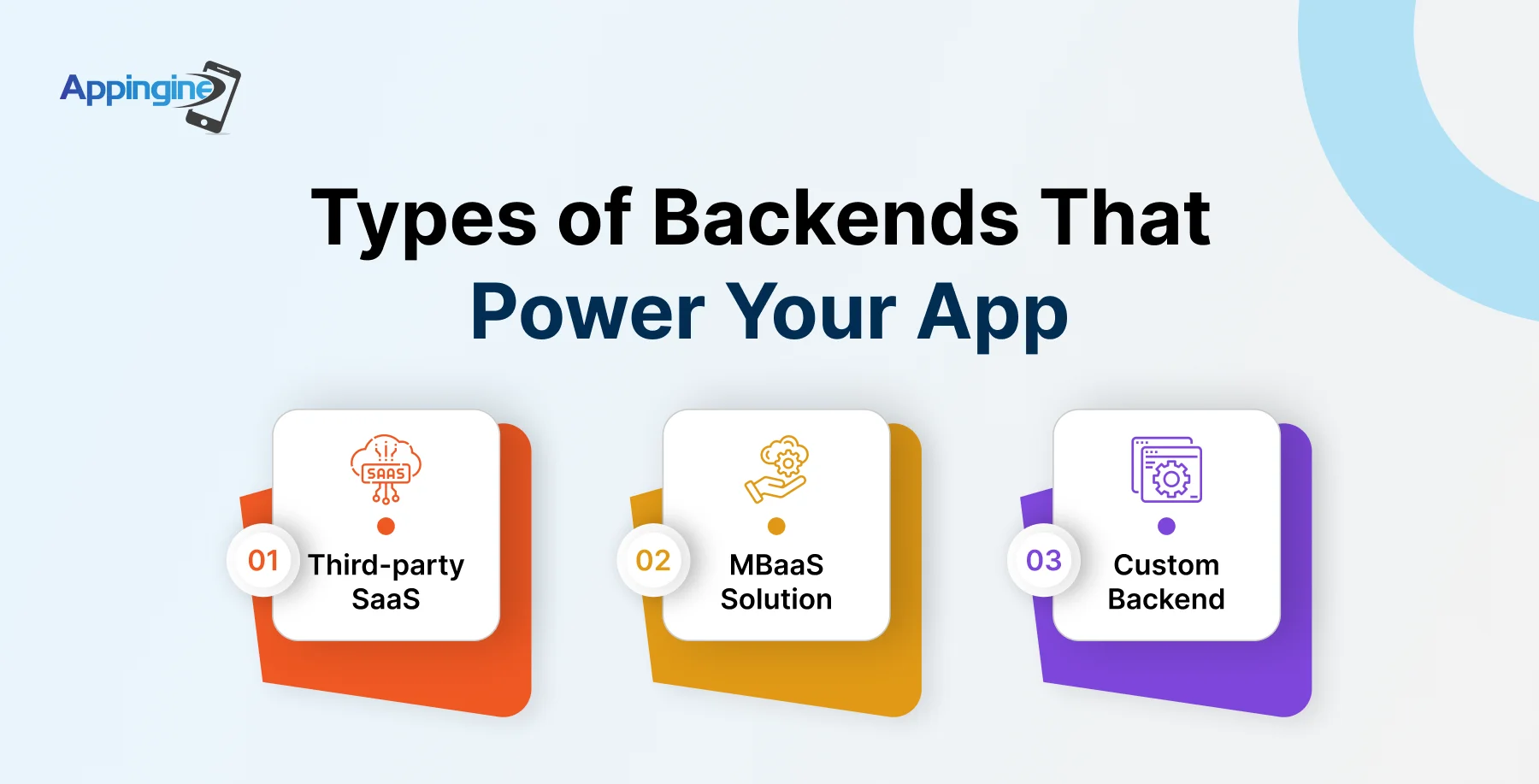
The solution you are planning to build may already exist in the market, and some platforms let you connect your app’s frontend to their backend service through subscription plans, either monthly or annual. These third-party mobile app backends or SaaS solutions are ready-made, plug-and-play options that can be simply integrated into your frontend by subscribing to their plan and launching your app.
Collecting data from the world, especially related to weather, was never easy. And that's where AccuWeather’s API jumps in. This API lets app developers access worldwide weather data which includes storms, forecasts, and current conditions, allowing them to pair the backend with an engaging frontend to launch an intuitive weather app for users.
Now there is no need to create complex algorithms to process millions of data points. All it needs is a simple subscription to the plan and paying a monthly fee to gain access to comprehensive global weather data.
Also Read: How To Develop An Accurate Weather App
Contentful Headless CMSUsing a headless CMS as a backend can be a great option if your app is all about content such as text, photographs, videos or other material. You can manage all material from a single dashboard and distribute it across several platforms with solutions like Contentful. Content management and distribution are made easy by the frontend's ability to retrieve any data stored in the CMS via APIs and present it to users independently in a variety of forms.
Low cost of backend development
No need for a backend development team
Shorter time to market, due to fewer development hours
Lack of flexibility in building and launching custom features
Monthly restrictions, while depending upon the plan
Limited scalability potential as the user base grows
Mobile Backend as a Service (MBaaS) is a scalable alternative that allows developers to utilize components while supporting custom code functionalities. Furthermore, MBaaS provides a basic structure that saves time and resources by eliminating the need to build a backend from scratch.
It takes full support of the components that are naturally provided and built-in libraries for common app features. App owners pay a monthly fee based on resource usage, such as the number of users, notifications, or traffic, and popular MBaaS solutions support both Android and iOS apps.
Firebase is a respected MBaaS solution that is supported by Google and offers a free trial to test and explore its possibilities. Firebase powers popular frameworks like Flutter and apps like Shazam, it also provides real-time database updates, crash reporting, cloud storage, and seamless hosting, giving it a dependable backend foundation for mobile app development.
ParseA popular self-hosted as well as an open-source backend solution that provides a complete SDK for building custom backend apps. It is compatible with multiple platforms such as Android and iOS. Other strong MBaaS alternatives that are named as RestAPI, GraphQL, and StackMob offer similar capabilities, with the best choice ultimately highly dependent on the app’s requirements and growth potential.
More customizable and flexible than SaaS backend solutions
Pay only for the resources you utilize
For embedding features and capabilities within the app, built-in components and pre-programmed libraries can be utilized
Backend service panics can damage your app's users.
Costs are higher for highly scalable programs that draw a large quantity of traffic in the long run.
Looking for complete customization for your mobile app? Then there is no better option than building a custom backend for your mobile app. However, it comes with additional responsibilities, which involve costs, hiring skilled developers, and more.
When your priorities are set to have an app with performance, security, and scalability, then a custom backend is the ideal choice. Especially in an era where privacy matters the most and minimizing third-party dependencies is important, custom backend app developments can set your app apart.
Wondering where to start from? The process begins with selecting the right tech stack. Node.js and Ruby on Rails are strong options and you can even adopt a hybrid model by using SaaS, MBaaS, and custom app backend elements that focus on your app’s needs and requirements. The smartest way to ensure the right path is to consult experienced backend app developers who can assess your requirements and customize a development plan accordingly.
Highly flexible according to the needs of the project
Ultimately scalable and reliable
Secure and protect data while not being dependent on third-party integrations.
Much costly than ever expected
Take a lot of time and specialized talent to develop and manage
Now that you know why the backend is important to be developed to run an application, you also have learned about multiple types of app backends. Let's go through the part that gives it a reputable scale in the app development procedure.
Databases work as a filing cabinet, which comes in two categories
Just like the frontend, there are computers for the backend systems as well and those are known as servers. There are two types of servers
APIs enable data requests to be transferred between the mobile application and the backend. For example, imagine a waiter picking up an order and bringing it to the kitchen. To make it easier for you to understand, here the mobile application works as a customer and the kitchen as an app backend.
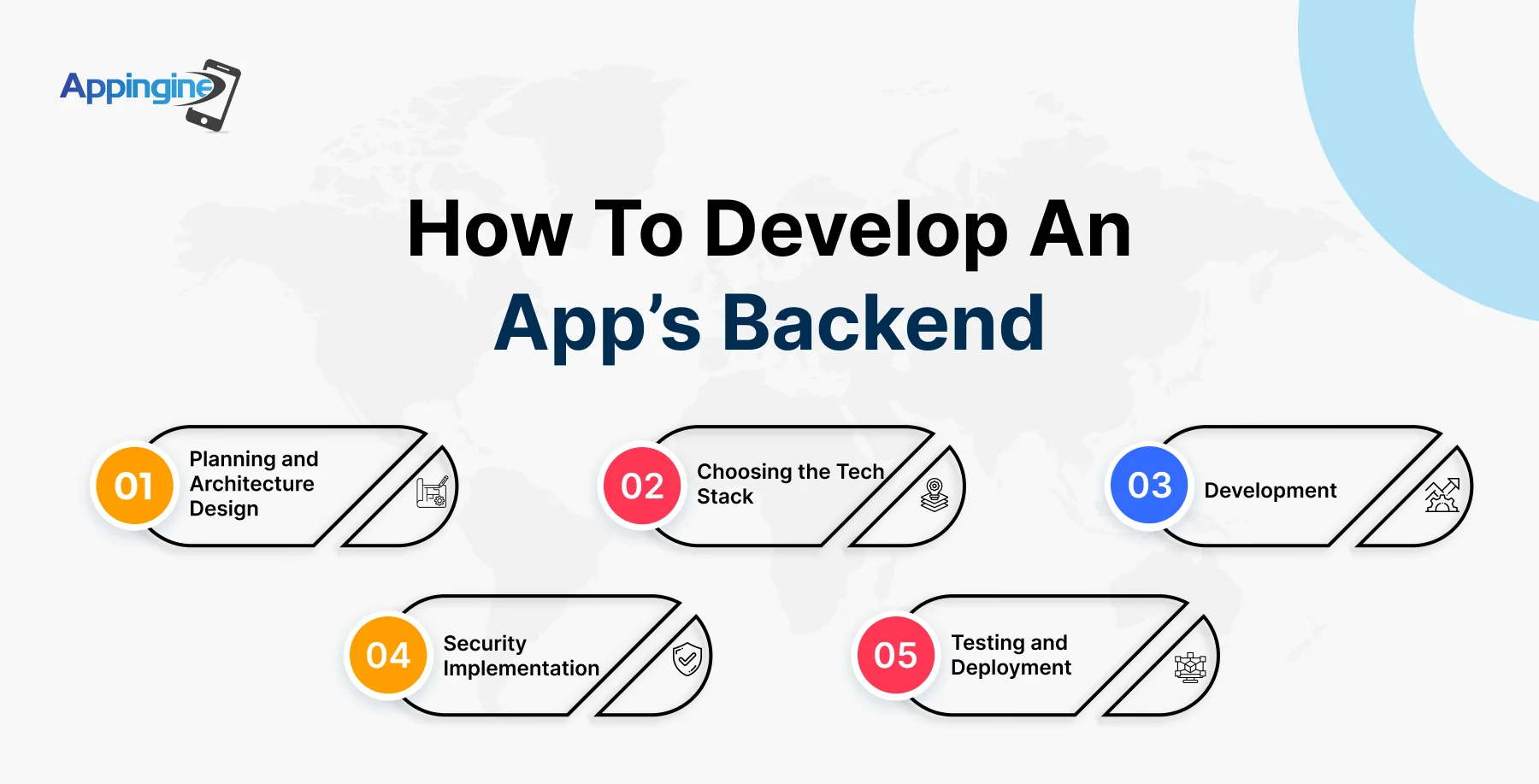
Are you planning on building your very own application, or is it the beginning of your career as a developer? Then, here are some of the key points of the procedure to build an app backend breakdown for you. Plan carefully and follow the given points to give your application a streamlined backend by taking advantage of the latest tools and technologies.
It is vital to have an understanding of the security measures to incorporate while developing the mobile app backend. Therefore, we have compiled some of the robust security measures that not only protect your app data but also prevent unauthorized access.
Let's have a look at your favorite products and explore how the complex system of the application works seamlessly to ensure data integrity, reliable interaction, and smooth transactions. For you, we have broken down some of the examples so you know how well crafted app backend can take user satisfaction, scalability, and overall app performance to another level.
With a strong backend infrastructure to manage billions of members and their activities, it is one of the biggest social media platforms in the world. For data processing and storage, its backend is constructed using a combination of open-source technologies like Hadoop and Cassandra and specially designed components. Facebook's backend system is built to be highly scalable, guaranteeing seamless operation even during periods of high traffic.
To provide millions of customers worldwide with a flawless experience, Netflix offers a well-known streaming service that depends on a very strong backend infrastructure. Their backend is smoothly powered by cloud-based technologies from Amazon Web Services (AWS). Moreover, what does Netflix offer? Netflix promises top-quality AWS services which include Amazon CloudFront for content delivery, Amazon S3 for storage, Amazon DynamoDB and more to manage user preferences and suggestions.
One of the best examples of a reliable and scalable system is Uber's backend. Uber's backend must effectively manage a huge volume of requests due to millions of daily transactions and real-time data processing in order to maintain the app's accessibility and responsiveness. Their backend is based on a mix of microservices and makes use of PostgreSQL for data storage and Node.js for real-time data processing.
Appingine is a well-known backend app development company that focuses on cutting edge tech stack to build high-performance, scalable, and secure infrastructures according to the requirements of your application. Our experts provide intelligent architectures, including many other mobile backend as a service that ensure smooth data flow, dependable performance, and real-time responsiveness.
If you are wondering what services we offer as an exceptional mobile app backend development agency, then you must visit our website and discuss your project with our expert team.
Get in touch with our mobile application developers and see how we can transform your app idea into reality.
Take Me To App Developers!To let the functionalities be seamlessly operated, empower every integration with secure data transfer and smooth performance that your users will love. During the development of a mobile application backend, choosing the right backend type to understand architecture, servers, APIs, and security is a necessity that shapes a reliable and scalable application.
With the evolution of technologies and tools in the digital world, a strong app backend becomes more important than ever. Whether you choose any of the types from SaaS, MBaaS, or a custom-built solution, investing in the right backend module ensures your app delivers remarkable user satisfaction.
Additionally, to protect all user data and details, our developers prioritize top-tier security with robust encryption and authentication protocol standards. We expedite development while providing affordable maintenance and support for a long term in an economical way by fully utilizing crucial frameworks and technology.
Frontend development focuses on what users see and interact with which includes app layouts, graphics and visuals, buttons, input fields and several other components, and user experience. Whereas, mobile application backend development powers the app behind the scenes with data processing, storage, security, and business logic to ensure smooth and reliable performance.
Without a backend, your app is just a static interface because the backend ensures data is stored securely, and users can interact seamlessly with your app. Platforms like Uber and Facebook handle millions to billions of transactions daily with our robust app backend systems.
There are three main backend types:
A robust backend typically includes:
Appingine implements best practices to keep your app secure from any breaches. Our developers design a high-performance and scalable mobile app backend that is capable of handling millions of requests daily. Our experts also optimize APIs, databases, and cloud server architecture for seamless real-time experiences.

Tel: +1 (800) 453-1297
Email: [email protected]
Main Office:
4929 Wilshire Blvd, Los Angeles, CA 90010
© 2026 Appingine. All Rights Reserved.