Appingine
Let's Discuss Your Tech Solutions

Camilla Lawrance

 10/28/2026
Picture this: a buyer relocating to Miami swipes through five different real estate apps in one evening. Four of them get deleted before bedtime. One survives on their home screen — and eventually leads to a $2M condo sale in Brickell.
What separates the app that gets deleted from the one that gets used, trusted, and shared? It's rarely the flashiest UI or the longest feature list. In a market as fast-moving and competitive as Miami — where inventory shifts overnight, international buyers make decisions from another time zone, and agents live or die by response speed — the apps that win are the ones built around how people actually decide to buy property, not just how they browse it.
This isn't another generic list of "must-have app features." It's a breakdown of what's actually converting leads into closings for Miami real estate platforms right now — from AI-driven property matching to hyperlocal flood-zone data that out-of-state buyers didn't even know to ask for.
Let's dig into what makes a Miami real estate app impossible to delete.
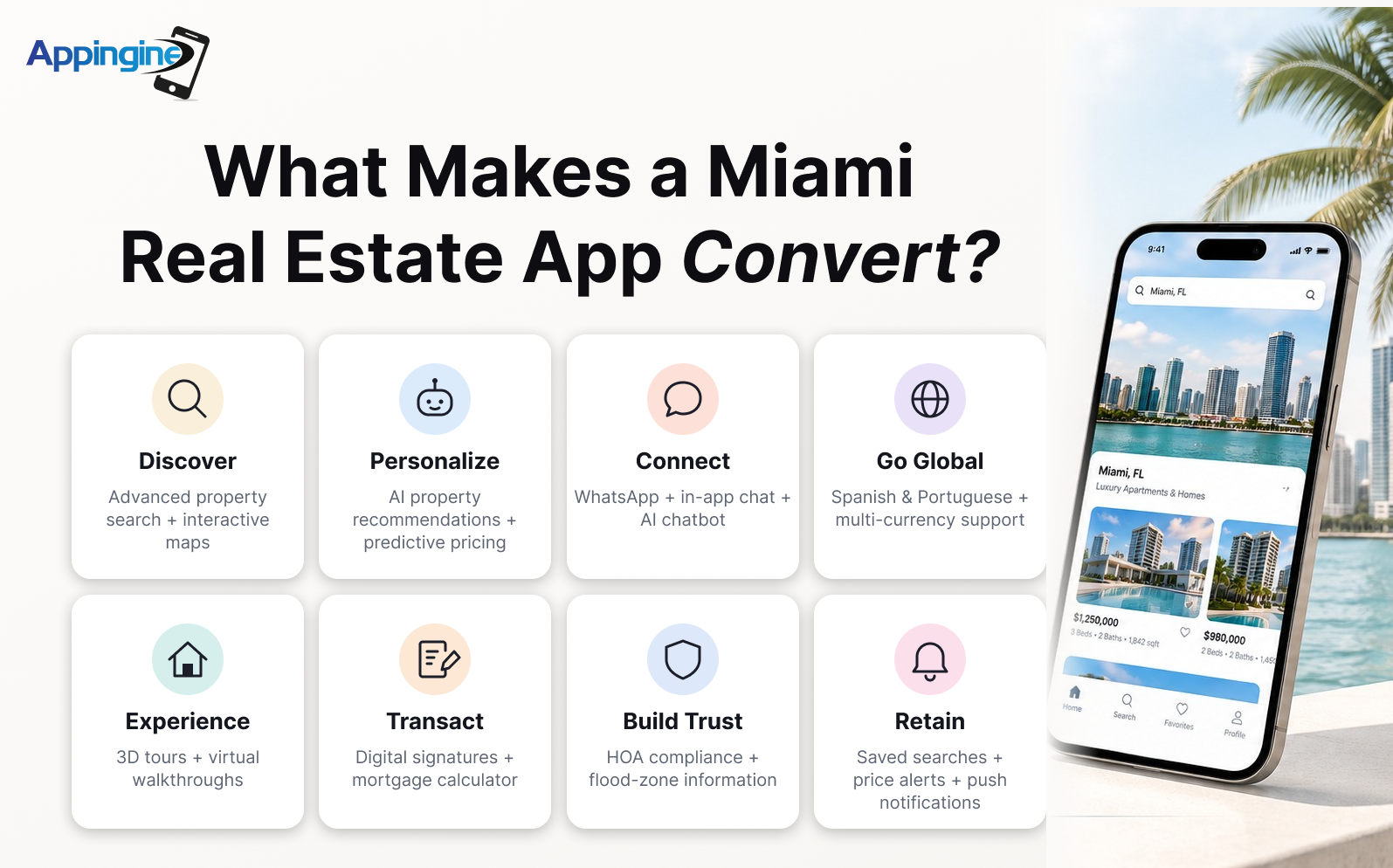
In-app communication, interactive maps, user profiles, property search, and a number of other crucial elements of real estate app development Miami are integrated to make it easy for buyers and sellers to locate the best one in town.
To compete in this market, the developers of the top-notch real estate app development firm in Miami include features like virtual walkthroughs, language support, and HOA compliance tracking. Some of the further functionalities and features are listed below.
Listings must be quickly found by users. Price, property type, square footage, and location are all covered by standard filters. Add filters for building amenities, condo association bylaws, and waterfront access in Miami.
Users can examine properties by area using a map-based search. In Miami, neighborhood information like school ratings, flood zone status, and transit proximity can also be layered in.
Different experiences are required for buyers, sellers, and agents. Each user has access to the tools appropriate to their role in the transaction thanks to role-based profiles.
Real estate selections are influenced by high-quality graphics. For agents on the go, your app must have quick-loading image galleries, video compatibility, and simple media upload features.
The process is accelerated when buyers and agents communicate directly. When communications come or the listing status changes, push notifications notify both parties.
Price reductions, new listings, confirmations and others keep users interested while encouraging them to return to your app in the future for more.
A completely immersive experience generates direct revenue in Miami, where foreign purchasers make remote purchases. Miami augmented reality app development goes beyond traditional 360-degree images to provide virtual tours. Before setting up a showing, buyers can arrange furniture, alter finishes, and look around.
MLS/IDX (Multiple Listing Service and Internet Data Exchange) connection exposes your app to the whole regional listing database, ensuring inventory accuracy and connectivity.
A mortgage calculator in the real estate app helps buyers estimate monthly payments instantly. Also, it reduces drop-off at the decision stage.
In real estate app development Miami, machine learning analyzes user behavior, searches, saves and time on listings, then surfaces relevant properties. To get sharper, more accurate recommendations, users have to spend more time in the app.
E-signature tools let agents and clients execute agreements inside the app. It removes friction from the closing process and speeds up every transaction.
Users save their search criteria and receive alerts when matching listings appear, or prices change. This feature drives repeat opens and keeps your brand top of mind.
An AI pricing engine examines similar sales, market trends, and local information. It provides buyers with real-time valuation assessments. This fosters trust and accelerates decision-making in Miami's rapidly evolving premium market.
An AI chatbot handles inquiries, qualifies leads, and schedules showings around the clock. For Miami's international buyers operating across time zones, automated responses keep deals moving.
Miami's buyer pool speaks multiple languages. Therefore, a multilingual interface removes friction for international buyers and signals that your platform can compete in the market.
Latin American and European buyers use WhatsApp as their primary channel by integrating it directly into your app meets them where they already operate.
Foreign buyers fund purchases differently. Your app needs to support international payment methods and display pricing in multiple currencies.
Florida's SB 4-D legislation requires condo buildings to meet new inspection and reserve fund standards. A compliance tracker surfaces this data inside the listing, giving buyers the information they need before they ask.
To handle those spikes without slowing down the app in the winter season, our backend app development guide covers database design, API architecture and server-side logic.
Miami's real estate market doesn't wait — and neither should your app. The platforms winning right now aren't the ones with the longest feature checklist; they're the ones that understand a Brickell condo buyer in Toronto and a first-time homebuyer in Kendall need fundamentally different experiences, delivered through the same seamless product.
Get the fundamentals right — fast search, real MLS data, frictionless communication. Then layer in what makes Miami different: multilingual support, WhatsApp integration, flood-zone transparency, HOA compliance tracking. That combination is what turns a downloaded app into a closed deal.
Build for how Miami buyers actually decide — and your app won't just survive the delete button. It'll be the one they open first.

Tel: +1 (800) 453-1297
Email: [email protected]
Main Office:
4929 Wilshire Blvd, Los Angeles, CA 90010
© 2026 Appingine. All Rights Reserved.