Appingine
Let's Discuss Your Tech Solutions

Camilla Lawrance

 04/08/2026
Choosing the right programming language for efficient and reliable software development can be a challenge, but not anymore, because this blog brings everything for you to make an informed decision for the long term success of your project. But among many programming languages, there are two tigers of app development, Python and Java.
When it comes to choosing between java and python, we are aware of the fact that both languages power the top applications, whether it is an AI-driven platform or data analytics tools, established systems for large enterprises, mobile applications for businesses of all sizes or whatnot. Both languages offer a vast collection of libraries, widgets and built-in extensions that make them popular for app development companies all over the world.
Before picking any of these, it is necessary to look for the requirements and goals of the project then learn basic and major differences between Java and Python. Followed by that, while counting on several factors and complexities, when we compare Java and Python according to their types, Java is well-known for its compiled and static type while, in contrast, Python is known for its interpreted and dynamic style.
Why is it a necessity to learn the difference between Java and Python? Well, it makes it easier for everyone, especially clients or developers to choose the language according to their project needs, which comes with a list of advantages as well as disadvantages. So, don’t skip any part of this blog if you are willing to develop an enterprise-level and rich-quality platform without compromising on the performance.
Partner with Appingine to get a quote and start developing secure, reliable, future-ready software solutions.
Let’s ConnectTo have a look at the difference and the enhancements of these programming languages, and the ongoing online fight about python versus java, lets have an in-depth analysis by counting on the market numbers for Python and Java separately.
Google Trends has highlighted the incredible rise in the popularity of Python and Java which were in a close race. However, in the few years since Python was introduced, developers in the app development community have consistently shown a strong preference for Python. And then it was noticed that Python has become the second-best choice of the most searched and picked programming languages with 58% of the developers wanting to work on it.
On the other hand, if we talk about Java, it has ranked seventh in the app development industry with 30.0% popularity. It comes with a list of services and benefits, which are offered by multiple functionalities. Since Python is gaining popularity over time, it doesn’t really mean that Java is becoming obsolete in the industry. It is still chosen by the app developers of the top companies for custom software development or enterprise-level projects.
After discussing the popularity and rise in the adoption of Python and Java individually. It’s time to list down various factors, which also include features and functionalities, pros and cons, and whatnot.
A high-level and interpreted language, released in 1991 which is not easily readable, but it is also dynamically typed, which is supported by structured and functional programming styles. Moreover, the best part that distinguishes Python and Java is their built-in data structures, which are combined with dynamic binding and dynamic typing.
If you are a beginner, then Python is an ideal choice that simplifies complex tasks and offers an open ground to focus on programming concepts efficiently. If you are wondering what this open-ground provides and makes python stand out in the competitive landscape. Worry less, because here is a breakdown of some exceptional libraries that enhance the functionalities as well as capabilities of python.
Here are some of the features listed for you that differentiate Python and Java successfully.
According to the factors and functionalities provided by Python, here we have gathered some of the advantages.
When there are advantages, there comes some limitations as well. Let's find out the cons of developing projects by using the Python programming language
Java is known as a general-purpose programming language due to its famous principle that is “Write once, run anywhere.” Java runs smoothly on multiple devices through an advanced Java Virtual Machine (JVM) which makes it a reliable choice for developers.
Java has been used in many applications that require reliability, security and high performance, some of the applications are listed for you.
Lets move forward to learn more about Java by going deep to look for the list of features that makes it an outstanding language and developers best choice
Many projects have taken advantage of Java functionalities and its capabilities. To advance their competence in the market, many of the organizations have adopted Java development. Here is a list of some of the benefits that Java leverages for an organization.
| Parameters | Python | Java |
|---|---|---|
| Code | Python generally has fewer lines of code. | Java has long lines of code.` |
| Framework | Python compared to Java, has a lower number of frameworks, such as Django and Flask. | Java has a large number of frameworks, such as Spring, Hibernate, etc. |
| Syntax | The syntax is easy to remember, almost similar to human language. | The syntax is complex, as it throws errors if you miss semicolons or curly braces. |
| Key Features | Fewer LOC (lines of code), rapid deployment, and dynamic typing. | Self-memory management, Robust, Platform independent |
| Speed | Python is slower since it uses an interpreter and also determines the data type at run time. | Java is faster in speed. |
| Databases | Python’s database access layers are weaker than Java’s JDBC. This is why it is rarely used in enterprises. | Java Database Connectivity is the most popular and widely used |
| Machine Learning Libraries | TensorFlow, PyTorch. | Weka, Mallet, Deeplearning4j, MOA |
| Practical Agility | Python has always had a presence in the agile space and has grown in popularity for many reasons, which includes the rise of the DevOps movement. | Due to static typing, Java offers more reliable refactoring. |
| Multiple Inheritance | Python supports multiple inheritance. | Java partially supports multiple inheritance. |
Share your requirements with us and receive expert advice on the best technology stack for your business goals.
Let’s Connect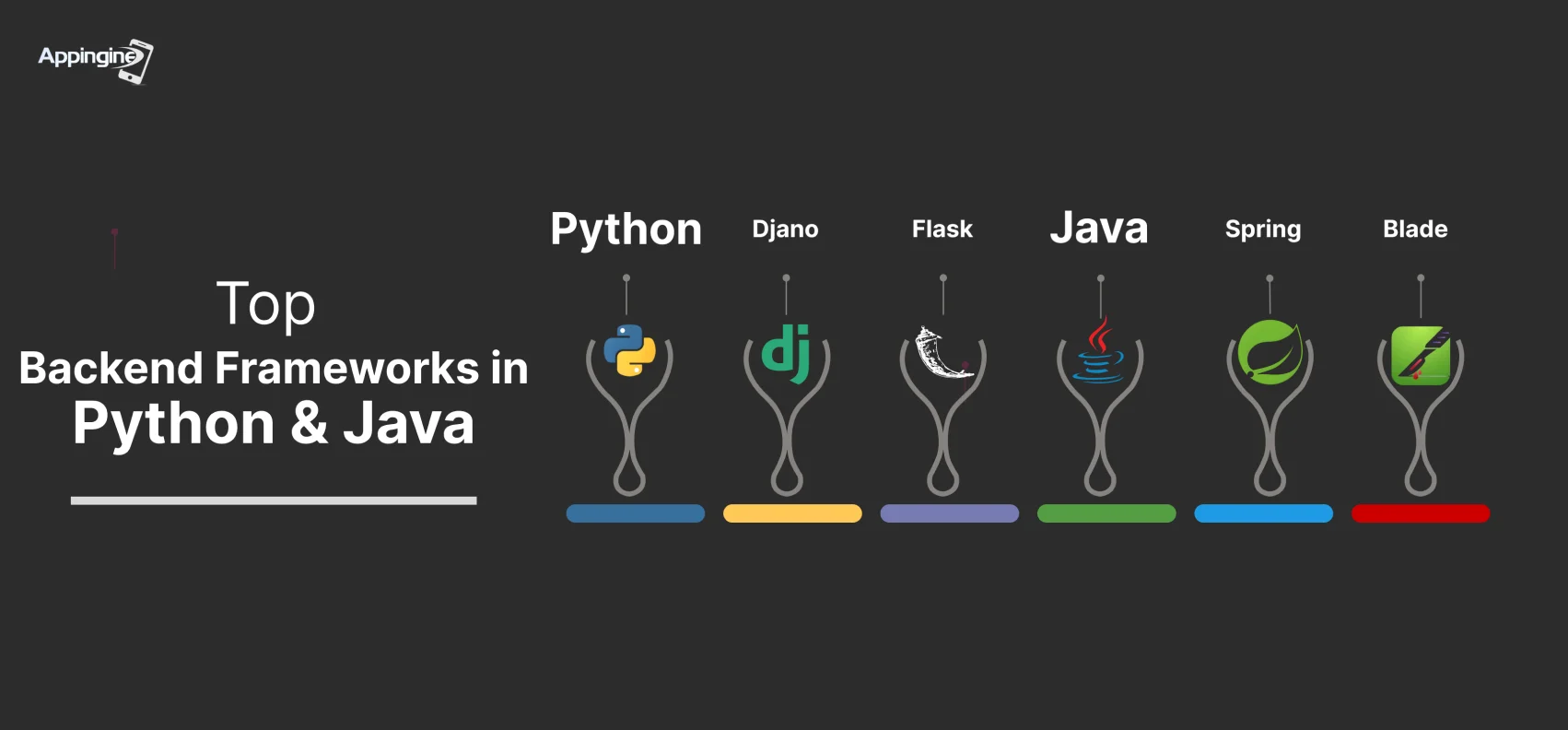
Programmers or developers, most of the time find themselves at a crossroads when deciding between the most widely used programming languages that are Python and Java. These languages provide a stable environment for creating applications with backend functionalities. Both languages feature frameworks that offer an organized method for creating scalable and maintainable applications, guided by the concepts of object-oriented programming.
Let's look at the backend frameworks for Python and Java.
Django: A high-level Python framework that follows the "Don't Repeat Yourself" philosophy and is designed for quick development with clear designs. Because Python places a strong focus on indentation, the app development experts find it effective for cutting down on lines of code while improving readability.
Flask: Developers that embrace minimalistic frameworks are fans of this micro-framework because of its fine-grained control and user-friendly environment. It is frequently selected for smaller Python systems when programmers wish to keep control over the parts they utilize.
Spring: Sun Microsystems created Spring, a solid framework that supports an object-oriented programming language paradigm and offers a thorough programming and configuration architecture for contemporary Java-based enterprise applications. It is renowned for its ability to function effectively on a variety of operating systems, including Linux and Windows.
Blade: For Java developers who want to create quick, scalable apps with less boilerplate code, this lightweight, high-performance framework stresses elegance and simplicity.
From our point of view, when choosing between Python and Java there is no such thing as one-size-fits-all. But, making the right choice depends entirely on the goal, scale and long-term vision of the project is the priority.
When choosing between python and java, and if you are seeking for the startup business, Python is an excellent option which also involves enhanced technologies and provides MVPs, AI-driven solutions, data-heavy applications and projects that demand rapid development and flexibility. Moreover, what makes python unique and ideal fit is Its simplicity, extensive collection of libraries and faster time to market when speed and innovation are top priorities.
But on the other hand, if the development of the project with complex features and functionalities with top security compliances, then Java remains the preferred choice that easily manages complex codebases and large scale projects, performance-critical systems, and apps that require strong security, scalability and reliable database connectivity. With its streamlined frameworks, JVM-powered performance and proven stability, Java ascends the reputable position in handling complex and large-scale architectures.
At Appingine, our expert app developers carefully go through the business requirements, technical needs and growth plans to recommend the programming language for the software development with high performance, long-term reliability and maximum ROI.
Whether it’s python or java that you prefer, let our experienced team turn your idea into a high-performance, scalable application.
Build Your App Today!The best approach is to learn about the requirements, goals and vision of the project and choose programming language for the development of the project accordingly. Therefore, picking the right one from Python and Java can make or break the future of the project by ensuring it falls perfectly with the specific requirements and technical needs.
When these languages, java and python are compared, we have learned that Python shines in scenarios that demand rapid development, flexibility and advanced data capabilities which makes it ideal for startups, AI-driven platforms and data-intensive applications. And if we talk about Java, it excels in performance-critical, large-scale and enterprise-level projects where the security, scalability and reliable database management are priorities.
When paired with the appropriate project needs, both languages can produce software without sacrificing quality and all of this has become a piece of cake with distinct pros, cons, extensive collection of large libraries and streamlined community support. Thus, you can choose the language that best suits the technical requirements, project scale, and long-term vision of the project while promising effectiveness, dependability and success.
The main difference between java and python lies in their execution and typing. Python is an interpreted, dynamically typed language which makes it faster to develop and easier to read, while Java is a compiled, statically typed language known for better performance, security and scalability in enterprise-level applications.
Python is generally considered better for beginners due to its simple syntax, readability and lower learning curve. Java, while more complex functionalities, helps learners understand core programming concepts such as object-oriented programming and memory management.
No, if we compare java and python, Java is usually faster than Python in terms of execution speed. Java’s compiled nature and Just-In-Time (JIT) compiler allow it to perform better in performance-critical and large-scale applications, whereas Python prioritizes development speed and flexibility.
Python is the ideal choice for projects that require rapid development, data analysis, machine learning, artificial intelligence, automation, or startups building MVPs. Its rich libraries and ease of use make it suitable for innovation-driven applications.
Java is better suited for enterprise-level applications due to its strong security features, robust frameworks like Spring and Hibernate, high performance, and reliable database connectivity through JDBC.

Tel: +1 (800) 453-1297
Email: [email protected]
Main Office:
4929 Wilshire Blvd, Los Angeles, CA 90010
© 2026 Appingine. All Rights Reserved.