Appingine
Let's Discuss Your Tech Solutions

Camilla Lawrance

 10/28/2026
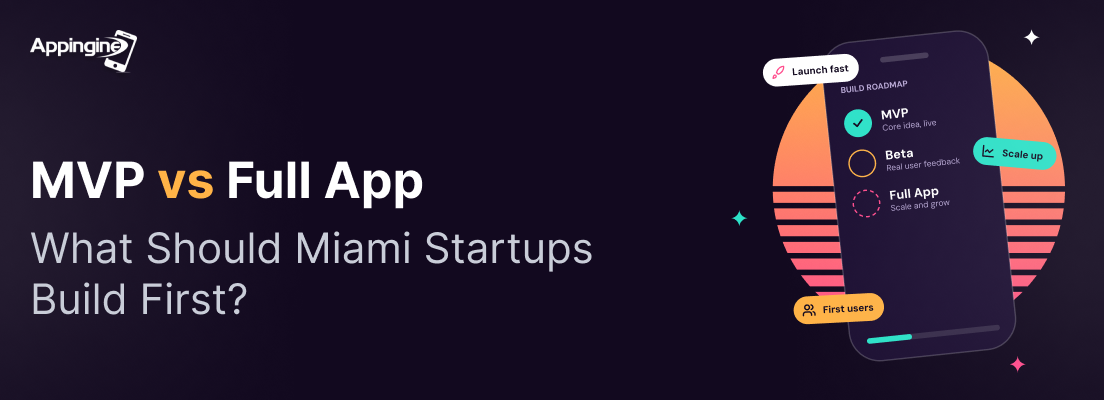
Miami's startup scene is having a moment. Between the influx of VC money, the "Miami Tech" migration of the early 2020s, and a growing pool of local talent from FIU, UM, and beyond, founders in the 305 have more resources than ever to build something great. But that same energy creates a trap: the pressure to launch big, fast, and polished — before you actually know what you're building.
This is for Miami founders who are debating whether to create a Minimum Viable Product (MVP) or launch the full-featured software.
In almost every case, especially for early-stage startups without a proven product-market fit, the MVP is the right call. Here's why — and when the "almost" applies.
An MVP development Miami isn't a half-broken version of your app. But it's the smallest product that allows you to test your main hypotheses with actual consumers and obtain actual feedback is a true MVP.
Think of it this way: if your startup idea is a ride-share app for boats (very Miami), your MVP isn't a stripped-down version of Uber with fewer features. It might just be a simple booking form connected to a WhatsApp group of five boat captains. The goal isn't to impress people — it's to learn whether anyone actually wants to book a boat this way, and what breaks when they try.
A good MVP answers questions like:
A full app is the complete vision — every feature, every edge case handled, every screen polished, scalable infrastructure, the works. It's what you build once you know the MVP validated something worth scaling.
Full apps typically involve:
This is expensive. It's slow. And building it before you know your product resonates with a real market is one of the most common — and most costly — mistakes startups make.
A few things about the Miami startup environment make the MVP-first approach especially important here:
1. Capital is available, but it's not free money. There may be a false sense of security because Miami has drawn significant investment in recent years. It's not a good idea to spend six figures developing a whole platform before you've verified demand, even if cash is more readily available. More and more investors are looking for traction rather than just a fancy app.
2. The market here is diverse — and diverse markets are unpredictable. With strong connections to Latin America, the Caribbean, and beyond, Miami is one of the most culturally and economically diverse cities in the United States. For a user in Hialeah or Little Havana, what works for a target user in Brickell could not work at all. Before making excessive investments in one area, an MVP allows you to test hypotheses across several sectors.
3. Miami's tech ecosystem is still maturing. Unlike Silicon Valley, Miami doesn't have decades of dense, hyper-specialized technical talent on every block (though that's changing fast). Hiring a full engineering team to build a complete app from day one is harder and pricier here than founders often expect. An MVP lets you move with a lean team — sometimes even a single contractor or dev shop — while you figure out what to build.
4. Early on, speed is more important than polish. Founders who act quickly and show up at the appropriate events, pitch competitions, and accelerator demo days with something genuine to present are rewarded by Miami's startup environment. A gorgeous full app that is still six months away from launch is inferior to an MVP that you can test.
There are exceptions. A full build-out from day one might make sense if:
Even in these cases, though, most experienced founders still build in phases rather than launching everything simultaneously.
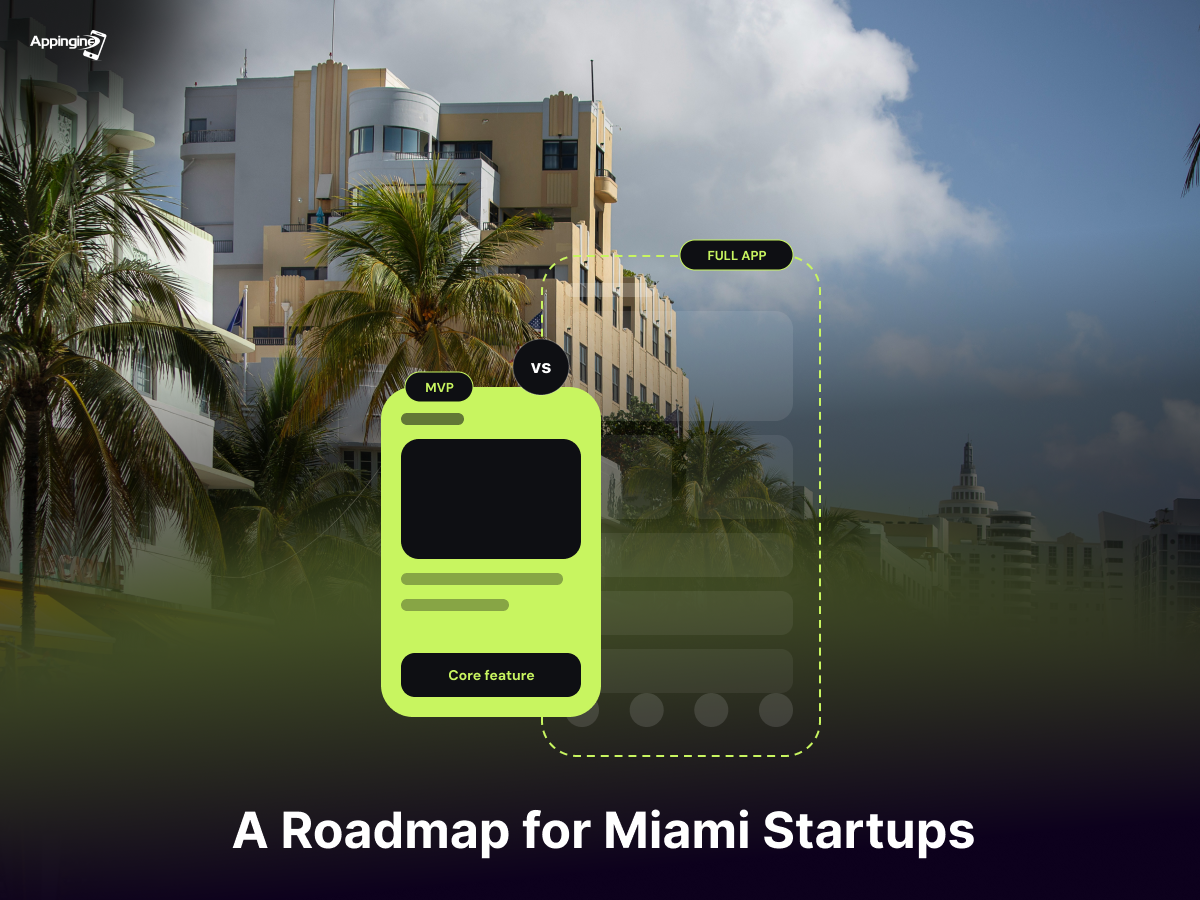
Miami's startup energy is real and the temptation to "go big" with rewarding ambition and visibility in MVP development Miami. But the founders who last aren't the ones who launched the most polished app first; they're the ones who learned the fastest what their market actually wanted.
Build the MVP. Learn. Then build the app your validated market deserves.

Tel: +1 (800) 453-1297
Email: [email protected]
Main Office:
4929 Wilshire Blvd, Los Angeles, CA 90010
© 2026 Appingine. All Rights Reserved.