Appingine
Let's Discuss Your Tech Solutions

Camilla Lawrance

 03/26/2026

Innovation is always the driving force behind software development, whether it's for a platform or not. Still, the emergence of generative AI has been revolutionizing the sector more quickly than ever. Intelligent technologies have reduced the time spent on manual coding, debugging, and brainstorming thanks to Generative AI's sophisticated capabilities. Moreover, many AI tools are capable of designing a complete workflow while offering suggestions for the enhancements. With the innovation of the technologies, these tools bring out the opportunity to unlock the new levels of creativity, efficiency and scalability, not merely automation, for both developers and organizations.
Generative AI is quickly becoming a crucial component of contemporary software development, helping developers with anything from code creation to improving testing, documentation, and user experience design. Businesses that use this technology are creating more intelligent, flexible digital solutions in addition to accelerating their generative AI development cycles.
You must be wondering how generative AI is impacting software development. For that, let's go through the entire blog, showcasing the best generative AI use cases and practical examples that demonstrate how this technology is changing the way software is created, developed, and implemented.
By transforming creative ideas to the high-quality product, Generative AI is transforming the process of brainstorming to product launch in a snap. Now, the product development team has realized that the development has gone to the very next level with this advanced tool. Generative AI is capable of producing new outputs, such as functional code, design mockups, user workflows, and even product copy, in contrast to classical AI, which mostly analyzes existing data. Moreover, it allows teams to rapidly build prototypes, experiment with different concepts and refine features much faster while making the entire digital product development process efficient and aligned with modern innovation.
Transform ideas into intelligent, user-centric solutions faster than ever with Appingine’s generative AI development.
Get Started with Generative AI| Aspect | Traditional Product Development | AI-Driven Product Development |
|---|---|---|
| Development Speed | Slower due to manual research, design, and coding | Faster with AI-assisted coding, automation, and rapid prototyping |
| Decision Making | Based on assumptions, experience, and limited data | Data-driven insights and predictive analytics guide decisions |
| Prototyping | Requires significant time and resources | AI tools generate prototypes quickly |
| Testing | Mostly manual testing and debugging | Automated testing and bug detection using AI |
| Personalization | Limited ability to personalize user experiences | AI enables highly personalized user experiences |
| Efficiency | Higher development effort and longer timelines | Improved efficiency with automated workflows |
| Coding | Manual, repetitive | Automated code generation |
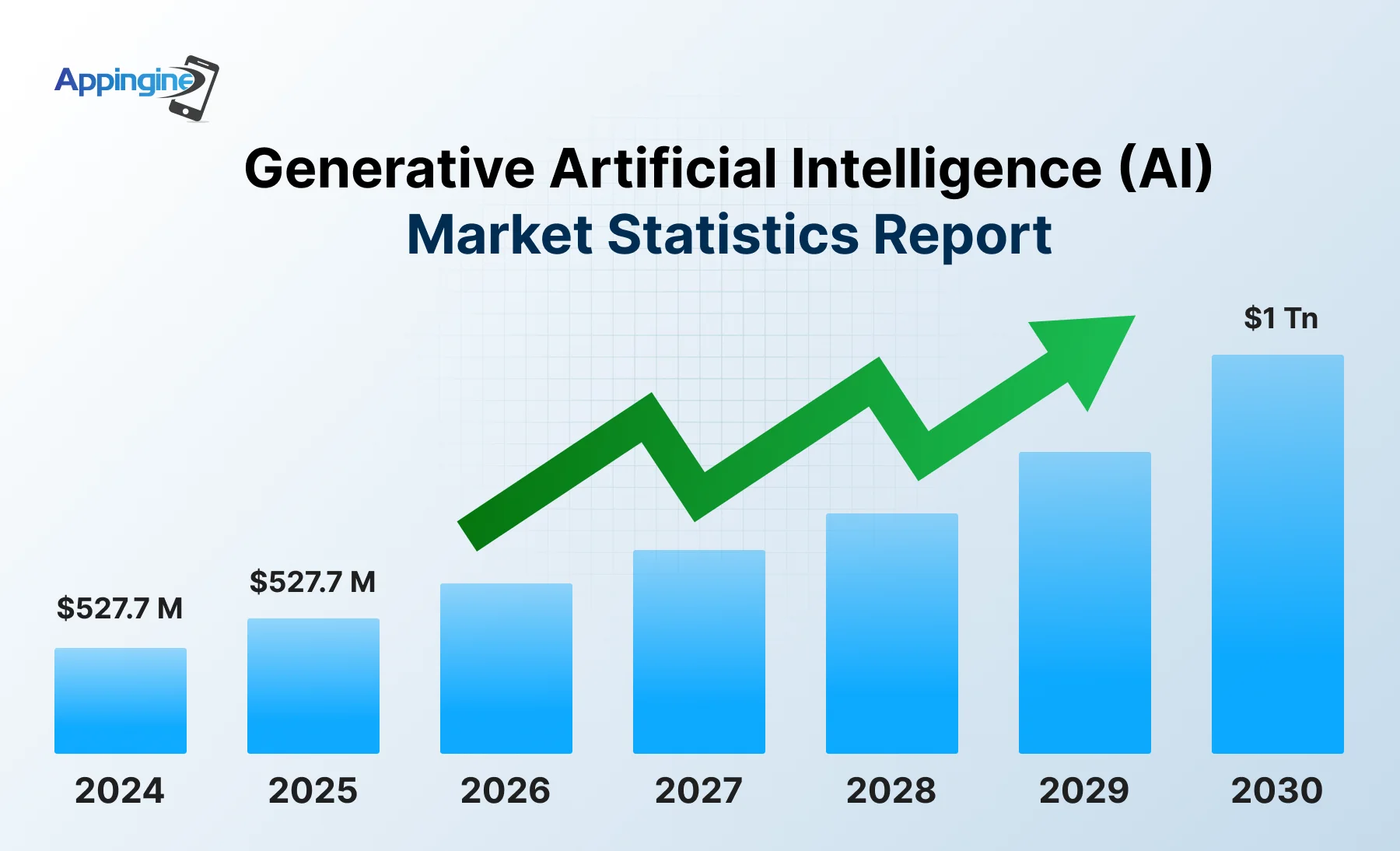
The global Generative AI market was valued at about $37.89 billion in 2025 and is projected to reach over $1 trillion by 2030, showing extremely rapid growth across industries.
The Generative AI product development segment generated around $527.7 million in 2024 and is expected to grow to $3.1 billion by 2030, with a 35.4% CAGR, highlighting strong adoption in software and digital product creation.
Code generation tools powered by Generative AI are projected to grow at a 53% CAGR between 2024 and 2029, making it one of the fastest-growing applications in software development.
Around 78% of organizations worldwide are already using AI in their operations, with many integrating generative AI into product design, development, and content creation workflows.
Product teams are discovering that AI in product development is transforming how digital products are built that are needed in the market, while going beyond speed to reduce costs along with enabling data-driven decisions and creating solutions users truly want. The latest gen AI product advancements empower teams to develop smarter, more focused products and bring them to market faster than ever before.
Following that, here we have listed down 7 Generative AI use cases that are currently reshaping product development while highlighting practical benefits and real-world examples that demonstrate tangible market impact.
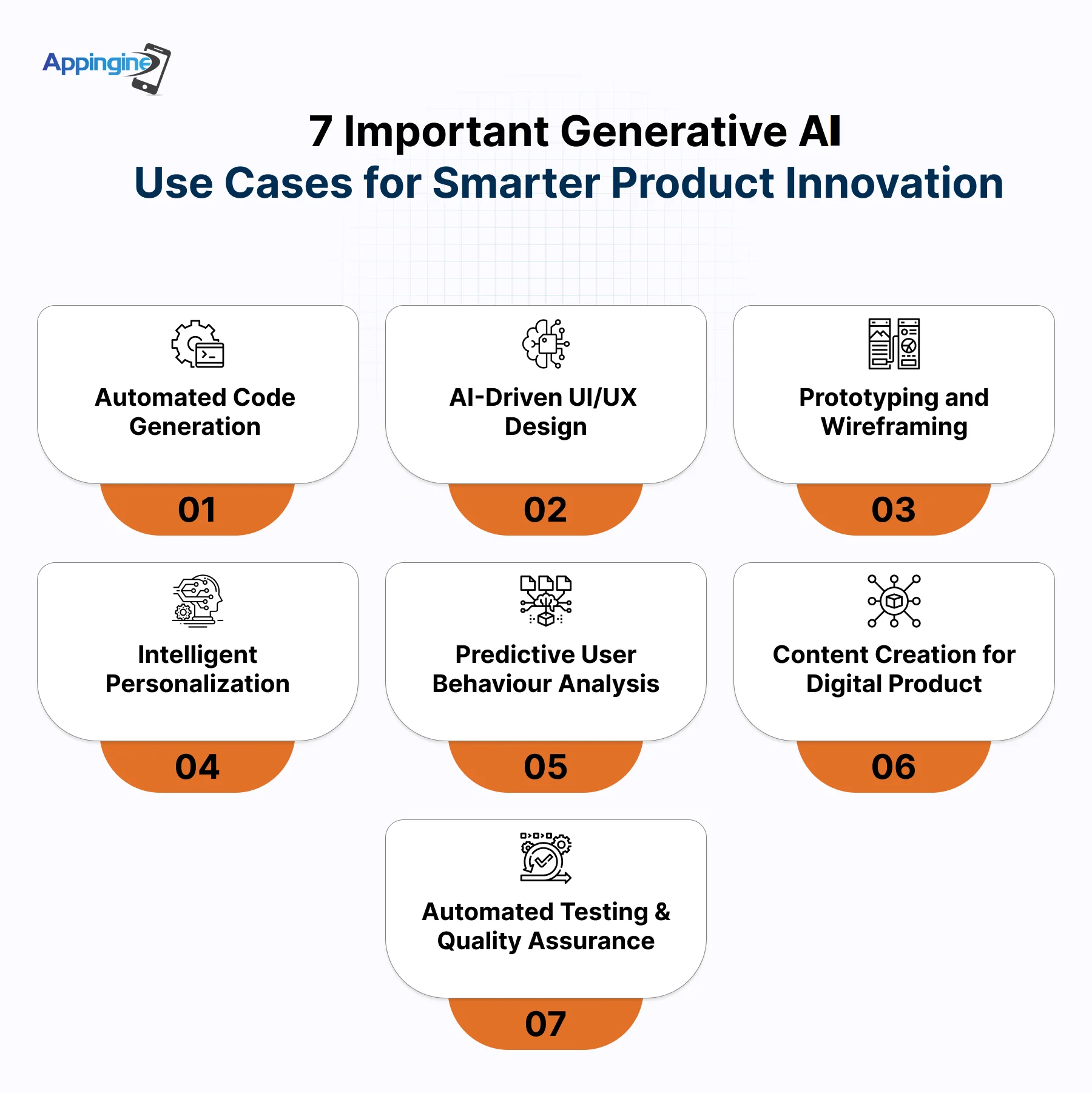
Generating high-quality and production-ready code for gen ai products has become easier than ever. With the help of simple prompts or partial snippets, alongside reducing the workload for product managers and developers. This shift is transforming generative AI for product development digitally by allowing teams to focus more on strategic thinking and creative problem-solving instead of repetitive coding tasks.
Here we have an example of GitHub Copilot that acts as AI coding partners while suggesting functions, generating full code blocks acting as intelligent coding partners, suggesting functions, and providing automated code review and debugging. Trained on billions of lines of code, it adapts to a developer’s style, accelerates development cycles, and greatly improves overall team productivity.
Faster product releases with fewer engineering hours, resulting in direct cost efficiency and quicker revenue realization.
AI is transforming digital product design by generating visual layouts, components and smooth user flows, brand identity, as well as users' requirements. This is where generative AI for product design truly adds value to the work of design teams that can rapidly test multiple layout options, iterate based on user feedback and refine interfaces in real time.
For example, tools like Figma AI make this process faster by instantly generating design elements while suggesting layout variations and creating multiple theme options within seconds. Its collaborative environment allows several team members to work on and refine designs simultaneously and reduces project timelines while making sure a consistent and engaging user experience across products
Faster alignment between product, design and development team leads to provide higher UX quality, stronger customer engagement and improved long-term user retention.
AI-powered prototyping tools are transforming how product ideas move from concept to validation by turning rough sketches or simple text descriptions into functional wireframes. This allows teams to quickly test concepts, gather feedback, and refine ideas before investing heavily in full development, while making it a perfect fit for agile workflows.
Let's take an example of generative AI use cases in software development in a platform like Uizard that can analyze hand-drawn sketches or written ideas and automatically convert them into interactive prototypes that users can navigate like real applications. Moreover, Product teams can then test these prototypes with real users, collect insights and iterate quickly without pulling product managers away from strategic work.
By delivering timely personalized experiences, generative AI in the digital product is transforming how it adapts users’ behavior, preferences and interactions. By automatically adjusting according to users’ recommendations, layouts and features, this combination of ai and product development helps products feel more relevant and engaging, which not just strengthens customer loyalty but drives higher revenue as well.
A strong example of intelligent personalization is Netflix, which uses generative AI and advanced data analysis to process massive amounts of viewing data, ratings and browsing patterns. This allows the platform to deliver highly accurate content recommendations and continuously adapt to user choices while creating personalized viewing experiences and helping reduce churn.
Personalization is a powerful growth lever, directly increasing ARR and maximizing customer lifetime value.
By detecting patterns in user behavior, businesses participate in the market shifts, optimize resources and reduce risks even before they appear. AI-powered code generation (e.g., GitHub Copilot, Amazon CodeWhisperer) speeds up the development and efficiently transforms how companies plan and make decisions by analyzing historical data to predict future trends by enabling product managers to act proactively rather than reactively
Duolingo is a prime example of predictive analysis, which takes full advantage to monitor learning patterns and identify when a user might be at risk of breaking their “streak.” The app then delivers personalized notifications that re-engage learners by driving higher daily active usage and significantly improving long-term retention.
Data-driven forecasting reduces wasted investment and ensures smarter, more confident product decisions.
Generative AI for product development is transforming how products communicate by instantly generating in-app text, onboarding guides, chatbot conversations and tutorials that feel natural and stay true to a brand’s voice. With the experts of generative AI, it has become easier to deliver polished content at lightning speed while cutting out approval delays and tedious rewrites.
Clear, interesting, and consistent messages are maintained by using tools like Jasper to create content for anything from interface microcopy and welcome flows to support documents. This allows marketing and product teams to reliably satisfy users, create high-quality content in large quantities, and free up time for strategic, creative work.
Scale high-quality content without increasing headcount, unlocking operational leverage and efficiency.
By taking over the repetitive and time-draining task of running thousands of user scenarios, catching issues before they snowball into problems, generative AI development services are revolutionizing product testing. This turbocharges quality assurance, accelerates time-to-market and keeps releases rock-solid even during frequent updates.
Testim.io is the best example of Automated Testing & Quality Assurance, which uses AI to craft smart, adaptive test cases that evolve alongside your product while spotting breaking points, flagging security risks and recommending actionable fixes automatically. Wondering what the possible outcome could be? Smoother deployments, higher-quality products and a user experience that just works every single time.
Higher release confidence leads to reduced downtime, lower legal risk, and fewer customer complaints, ensuring a smoother, more reliable product experience.
Moving on to the list of advantages that show the importance of generative AI in product development.
Automate coding, design, testing, and content creation to stay ahead of the market.
Explore Our AI ServicesWhen used effectively, AI and product development such as generative artificial intelligence (GenAI) is quickly becoming a potential driver for product creation. GenAI has given a new meaning to the companies that are creating, developing and delivering digital goods by speeding up product development, boosting marketing and increasing consumer experiences. Also, it enables organizations to gain more intelligent insights, optimize workflows and advance their product goals by integrating smooth data management, predictive analytics and gen AI product capabilities efficiently.
Businesses are now fully utilizing ChatGPT's concepts to improve operations with contextualized, safe AI solutions and more. ChatGPT is the first chatbot that is powered by GenAI and is accessible around the globe. These conversational AIs can change customer interactions and increase revenue. For example, intelligent chatbots that offer transaction histories, thoroughly explain bills, and even recommend customized product packages or contract terms based on previous usage can increase customer satisfaction and business opportunities.
Generative AI development services are transforming product modernization by automating tasks that once required extensive manual effort. It has the ability to analyze publicly available sources like press releases to gather competitor insights, assess market advantages and suggest strategic product changes, all at extraordinary speed.
A major advantage of generative AI development is its ability to generate, refine and optimize code while identifying and remediating technical debt, which allows business users to develop preliminary features and identify or fix bugs without heavy reliance on technical teams.
With the help of generative AI in product development, many organizations can take advantage of the services it offers and determine the best moment to launch new products to certain clients, advise appropriate offerings and recommend the next steps for engagement by fusing predictive analytics with generative AI. For instance, predictive algorithms trained on previous transactions might detect possible product needs when a customer experiences a significant shift, like an acquisition.
In order to facilitate quicker and more efficient client interactions, generative AI for product development can then highlight upselling prospects and even create customized letters for sales teams to examine.
Enterprises can now take advantage of large language models (LLMs) as part of generative AI development services to revolutionize customer experience by rapidly acting on feedback. AI models can interpret and summarize large volumes of customer input and highlight key insights. Generative AI development can then suggest product improvements, complete with detailed requirements and user stories, speeding up responsiveness and innovation. Additionally, by analyzing feedback from lost customers, it can reveal trends, propose new sales strategies and equip sales teams with actionable intelligence and pre-crafted follow-ups along with driving smarter business decisions.
With the advancement in technology, generative AI for product development is taking over the digital marketing sector as well, which speeds up, improves and personalizes campaigns. Businesses may precisely target the proper audiences by using data analysis to find customer patterns and clusters. GenAI provides technologies that simplify daily marketing activities, increase productivity and reduce expenses, as well as automated content generation and outreach across several platforms. It is revolutionizing modern marketing because of its capacity to transform costly, labor-intensive, manual marketing procedures into quick, automated workflows.
To understand how the team plans to build, test, polish and deploy the product from the beginning till the end, generative AI and product development combine the process of automation and smart analysis. Here is the list of benefits of the advanced technologies, like Generative AI in product development
Every step of product creation is being accelerated by AI which gives companies a free hand to outperform their rivals. Teams may quickly change course in response to real-time customer input by automating repetitive operations and eliminating obstacles. This is the magic of generative AI in digital product innovation: while rivals are still planning, it transforms concepts into workable products. By grabbing chances and keeping teams ahead in the innovation race, generative AI in product development helps launch it as soon as feasible to streamline processes and faster iterations.
For product teams, generative AI opens up a world of creative possibilities by producing novel design concepts, feature ideas, and methods that frequently astound even the most seasoned humans. One of its greatest benefits is that it breaks past conventional creative barriers by offering original ideas that teams would not have thought about. Therefore, a gen AI product allows companies to experiment freely, iterate quickly and explore new ideas without worrying about inflated budgets or stopped projects, resulting in speedier innovation and more creative products. It can produce dozens of variations and improvements in minutes.
Long after a product is launched, generative AI continues to improve and refine it, taking product evolution to new heights. It enables goods to change proactively rather than in response to issues as they arise by monitoring performance, predicting user needs, and making real-time feature adjustments. AI keeps products current, relevant, and ahead of the competition with everything from minor interface adjustments to completely new features based on real user behavior. The result? Customer engagement, more seamless interactions, and goods that are vibrant, always evolving, and precisely in line with consumer expectations.
By mimicking how goods function in harsh environments and real-world situations before anything is constructed, artificial intelligence is transforming product testing. Teams may identify problems early, avoid expensive errors, expedite development, and guarantee adherence to safety, quality, and regulatory requirements from the outset by running designs digitally first. Teams may quickly assess several design possibilities using these simulated tests, selecting the one that works best and lasts the longest. Stronger products, happier consumers, and a competitive advantage that keeps businesses ahead of the competition are the outcomes.
From ideation to intelligent code generation, turn your next product vision into reality with Appingine’s generative AI expertise. Our experts are available to assist you in building smarter, faster and more user-centric products. Moreover, by taking full advantage of the AI to automate repetitive tasks, generate content, suggest features and even remediate technical debt, everything is seamlessly maintained while keeping your product innovative and reliable. With Appingine, maximize user experiences along with making informed decisions that give your product a competitive edge.
Harness Appingine’s generative AI capabilities to enhance user experiences and drive growth to your business.
Hire ExpertsBy fundamentally transforming software and digital product development, Generative AI in product development is enabling teams to move faster and smarter than ever before. By automating coding, design, prototyping, testing and content creation, AI enables teams to have an open ground on strategic thinking, creativity and innovation, while also improving product quality and consistency.
Moreover, generative AI brings a vast collection of tools like LLMs, AI-powered debugging, and technical debt remediation that ensure that products are streamlined, maintainable, and reliable, while predictive insights and personalization enhance user engagement and retention.
For companies ready to embrace the future of product development, Appingine combines AI expertise with practical solutions to help build smarter and more user-centric products that deliver a competitive edge in today’s rapidly evolving market.
Generative AI can create new outputs, such as functional code, UI designs, content, and workflows, rather than just analyzing existing data like traditional AI. It accelerates product development by enabling rapid prototyping, automating repetitive tasks, and providing data-driven insights for smarter decision-making.
Generative AI tools automate tasks like code generation, testing, and design iterations. This reduces manual effort, shortens development cycles, and allows teams to focus on strategic problem-solving. Organizations can launch products faster while maintaining high quality and consistency.
Yes. By analyzing user behavior, preferences, and interactions, generative AI can deliver personalized recommendations, UI layouts, and content. This increases engagement, reduces churn, and improves customer satisfaction, making products more relevant to individual users.
Key use cases include:
These applications help teams innovate faster and reduce costs.
Generative AI accelerates time-to-market, boosts creativity, enables continuous product optimization, and enhances risk prediction. By streamlining processes, improving product quality, and providing actionable insights, businesses can make smarter decisions, deliver more user-centric solutions, and maintain a competitive edge.

Tel: +1 (800) 453-1297
Email: [email protected]
Main Office:
4929 Wilshire Blvd, Los Angeles, CA 90010
© 2026 Appingine. All Rights Reserved.