Appingine
Let's Discuss Your Tech Solutions

Camilla Lawrance

 04/16/2026
Fintech application development has become an important part of everybody's lives by not just transforming how users interact with money but also making new currencies. Since money moves fast in today’s digital world, from mobile wallets to AI-driven investment platforms. With the growth of the Fintech industry, there are cyber risks that can compromise millions of users within seconds. Welcome to the world of cybersecurity in the fintech industry!
As cyberattacks become more relentless, building a financial app is more about building trust and resilience and uncompromising fintech security and no longer just about user experiences. Whether you're planning on launching a new FinTech solution or improving the presence of an existing platform, ensuring cybersecurity in fintech isn’t optional, but it has become a mission.
With the development of the latest software and applications across several industries, the Fintech industry has no way stayed behind the trend to lead in the competitive market. According to Statista reports, the United States has the highest number of fintech companies around the globe, with nearly 12,000 and followed by Asia Pacific (6,365) and EMEA (Europe, the Middle East, and Africa) at about 9,200.
Fintech companies are just the beginning, but with time, the increasing number of users and their demands for software for fintech and cybersecurity are also being noticed. Therefore, according to Statista reports, by 2028, 80 million Americans are expected to utilize digital banking. Given how simple and convenient mobile banking is for customers, this figure might exceed the estimate.
So, how do you safeguard sensitive financial data, prevent breaches and stay ahead of evolving threats? Let’s break down the essential strategies to make your financial app.
Leverage expert development and advanced security to launch with confidence.
Hire FinTech ExpertsFinTech has advanced, enabling speed, convenience, and more intelligent banking experiences as digital payments become commonplace. However, this quick expansion is accompanied by an equally aggressive wave of cyberthreats, including sophisticated fraud schemes and data breaches that can quickly undermine customer confidence.
Today's financial apps are great targets for hackers looking for valuable data since they are at the heart of a high-stakes economy. To keep one step ahead of changing assaults, top FinTech innovators prioritize secure transactions, unbreakable data protection and proactive threat prevention while treating cybersecurity as a fundamental basis rather than an afterthought.
A single financial app data breach is more than just a technical issue—it's a major emergency. The 2019 Capital One data breach, which revealed the information of over 100 million clients, demonstrates how catastrophic a single vulnerability can be if we delve deeply into the history of Fintech.
And while traditional banks operate under strict fintech security regulations, many fintech companies move fast in less regulated environments, from banking credentials to transaction histories. Because of this, cybercriminals find them to be very appealing targets. The risk increases when you consider the quick speed of fintech development, which occasionally surpasses security.
The consequences? Financial loss, legal repercussions, harm to one's reputation and whatnot. Because consumers entrust the system with their savings, investments and personal information, if cybersecurity fails, not only is money lost but trust is also lost. To be safe and gain enduring confidence, contemporary financial systems must go beyond the fundamentals and adopt robust encryption, intelligent fraud detection, and real-time threat response.
Because hackers are always playing manipulation games with sensitive data and breaking security procedures, data breaches and cyberattacks are regularly reported in the media. In addition to costing businesses millions of dollars, a successful attempt by these hackers can damage a company's reputation and credibility in the marketplace.
One of the largest data breaches of the century, for example, cost American multinational consumer credit reporting giant Equifax close to $4 billion in a matter of days. The cost of implementing robust security measures was greatly outweighed by the loss. The company spent almost $1.4 billion on cleanup expenses two years after the incident, which included changing the pricing of IT infrastructure and enhancing app and data security. On the other hand, developing a safe finance app only costs between $50,000 and $200,000 (more on this later).
Following that, here we have listed down some of the examples of attacks overcome by taking notes on the fintech security standards recently.
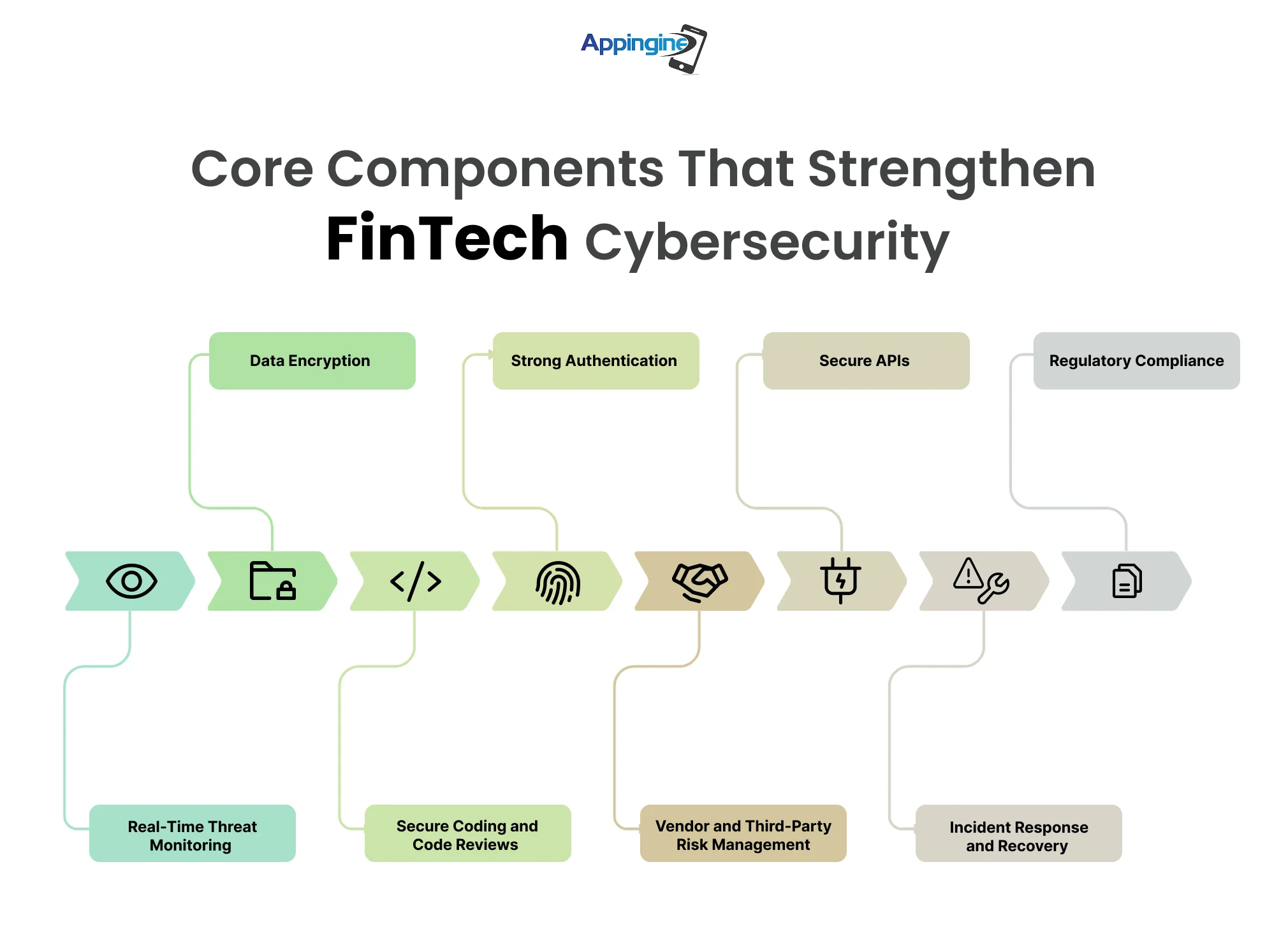
Cybersecurity in fintech isn’t just protection but it is considered to be the backbone of the mobile app security solutions for banking apps. Safeguarding financial transactions and sensitive user data, meeting strict fintech security standards, has become critical. Here are the key pillars every fintech company must prioritize to build resilient security for the applications of the fintech industry.
To be more protective of data during transmission and storage of all private and sensitive financial information, encryption is a major aspect. Moreover, encryption standards in financial condition, strong encryption standards aid in preventing unwanted access.
Use role-based access restrictions and multi-factor authentication to make sure that only authorized personnel and verified users may access vital systems and customer information. Using fintech consulting services can offer professional advice for putting these strong security measures in place.
To avoid vulnerabilities and illegal access points for fintech platforms, APIs must be carefully designed, tested and secured.
Aligning with the standards like PCI, DSS, GDPR and more is necessary to avoid fines and foster long-term investor and customer relationships while trusting financial offerings.
Ongoing monitoring systems should be in place to identify anomalous behavior immediately, enabling prompt responses to potential breaches and mitigating the impact of attacks.
Ensure applications for fintech and cybersecurity should be designed using secure development approaches, with regular security audits and peer code reviews to find vulnerabilities before going into production.
To prevent bringing hidden threats into their environment, fintech companies need to closely monitor the fintech and security standards of cloud providers, API vendors and other third-party partners.
For prompt containment, open communication and swift recovery from cyber disasters, it is necessary to have a well-defined, documented and routinely tested incident response strategy.
To safeguard sensitive data and transactions, one of the most effective ways is to build a custom mobile app security solution for financial services that is designed with easy navigation and a security-first architecture.
However, it is not a small feat to develop a secure fintech app. With the increase in the demands for deep technical expertise, industry experience and a clear understanding of critical compliance standards such as PCI-DSS and GDPR has taken the user expectations to the next level.
While the overall development process may be the same as the traditional mobile app creation, fintech requires a sharper focus on advanced security practices to ensure the app stays reliable and a key to succeed in the competitive market for the long term along with gaining full user trust.
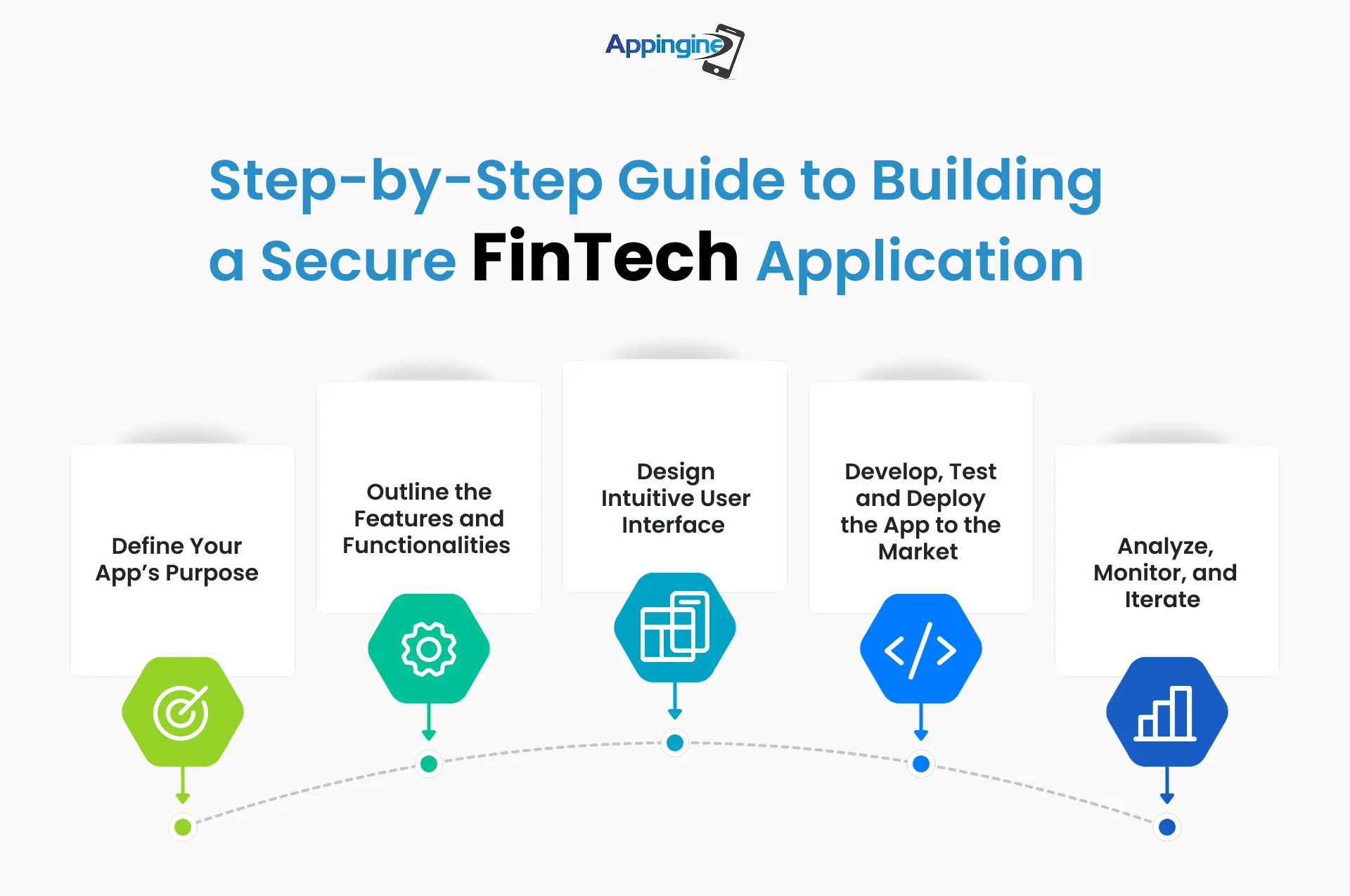
Here’s a step-by-step guide to building a secure yet future-ready fintech application:
The first step of the fintech app development process is to understand the goals and vision, and the kind of fintech app that will work best for you. Whether you are going for peer-to-peer lending, investment management, loan sanction, mobile banking or any other financial business, would you need a fintech app security solution?
Now, based on your product’s brief, the core features and functionalities of the fintech application are outlined. No matter what specific purpose your app serves, you must consider adding the basic security features like user authentication, secure transactions, account management, personalized notifications, real-time data updates and analytics; and build a roadmap accordingly for development.
An intuitive interface is the oxygen for the application of any genre, especially for fintech applications. Therefore, building an easy-to-navigate and visually appealing interface is the key that guides users through various functions. Also, help them pay attention to convenience, accessibility, security and transaction flows to ensure a seamless UI/UX design.
Now, here comes the time to develop a fintech application by using the right tech stack and following an agile approach to develop a high-level, secure and robust fintech application. Once developed, conduct thorough testing to identify and resolve any bugs or errors before launching it to the market.
The process doesn't just end after the successful launch of your financial app but it is just the beginning of the process. To guarantee your app's continued success in the financial industry, you must continuously assess timely performance, user engagement, feedback and security measures. Moreover, to improve the app's performance based on user input and market trends, you can employ analytics tools to stay put with the security standards and learn about user behavior, respectively.
Build innovative, compliant, and high-performance financial applications that users trust.
Build With Appingine Now!Building a secure fintech app isn’t a one-size-fits-all investment but it’s hard to shape according to your vision. From the platforms you choose and the type of app you’re creating to its features, complexity, security layers, and even the location of your development partner, every factor plays a role in defining the final cost.
Because of these variables, pinpointing an exact figure without clear requirements can be challenging. However, as a general benchmark, developing a fintech application can range from $50,000 to $300,000+, depending on the scope and sophistication involved.
Now that you have a clearer picture of the development process and potential investment, let’s dive into the best practices that will keep your fintech app secure, resilient, and ahead of evolving cyber threats.
It is now more crucial than ever to incorporate proactive fintech security measures into applications due to the growing danger of data breaches and cybercrime with the evolution of technology. Even a little failure in a fintech app security can have serious consequences, legal ramifications and reputational harm. Therefore, when developing a fintech app security solutions you have to take best practices into account.
The financial technology industry is controlled by stringent standards. Therefore, you must be familiar with the fintech security standards to safeguard user data and promise cyber security in fintech. To gain users' trust and match security compliance standards, ensure your app complies with general laws like the General Data Protection Regulation (GDPR), Know Your Customer (KYC), PCI-DSS, and Anti-Money Laundering (AML).
Building a secure solution that fully protects fintech data security means integrating fintech security at every stage of the application. Therefore, when building a fintech cybersecurity app, you need to ensure the data that needs to be stored, where to be stored and accessed by whom and more. Moreover, make it easy for the users to use the application, and to do so, try to keep your app’s architecture simple and store only the minimal yet crucial data so that the app can be secured from hackers who cannot steal sensitive information from your system.
For example, build a secure payment gateway that does not ask for the customers’ card numbers.
Secure coding is the backbone of a fintech application. If your code has even the smallest vulnerabilities, your entire effort of building a secure application may go in vain, bringing your business at risk. Therefore, the tech experts who deploy the code should consider proper logging, input validation, password management, handling of errors, authentication, cryptography practices, and secured communication.
The fintech app security solutions determine the success of the fintech industry. Therefore, when building a fintech app, integrate strong security measures such as biometric identification, two-factor authentication, data encryption and secure APIs.
By integrating these cyber security in fintech and security features into the app, businesses can successfully face the fintech cybersecurity risks while building fintech app security solutions.
After discussing every crucial component that a fintech cybersecurity app solutions one must follow, let's have a look at a few financial apps that are dominating the fintech market.
The fintech sector offers a wide range of applications, each with special features and functionalities that meet the various needs of users. These practical applications came with their flawless functionality and user experience. Let's have a look at the finest examples of mobile app security solutions for financial services
PayPal is a well-known P2P payment program that facilitates online shopping, money transfers, and money management. In order to enable safe and easy transactions, that fintech solution enables users to link their bank accounts, debit cards, and credit cards with the application. PayPal's popularity and easy-to-use interface provide both consumers and businesses with quick and secure payment options, guaranteeing safe transactions and peace of mind.
Mint is a feature-rich personal financial tool that enables users to effectively manage their finances and keep track of their expenses. It easily connects to users' bank accounts, credit cards, debit cards, and bills to provide tailored information and assist clients in making wise financial choices. The app's user-friendly interface, strong security features, and best practices for utilizing blockchain, IoT, AI, and other fintech cybersecurity advancements make it a safe option for its millions of users worldwide, assisting them in managing their finances.
Since, with time, the threats are becoming advanced, fintech companies must adopt proactive, adaptive, and intelligent security strategies to stay ahead. Therefore, here is the list of the future trends that are taking place in the fintech market and making financial businesses grow like never before.
| Trend | What It Means | What It Means | Impact on Fintech |
|---|---|---|---|
| Artificial Intelligence | Artificial Intelligence is used by both defenders and hackers to automate detection and attacks | Faster threat detection but also more sophisticated, large-scale cyberattacks | |
| Zero Trust Architecture (ZTA) | “Never trust, always verify” approach with strict identity and access controls | “Never trust, always verify” approach with strict identity and access controls | |
| Post-Quantum Cryptography | New encryption methods designed to resist quantum computing threats | Future-proofs financial data against potential decryption by quantum machines | |
| Biometric & Advanced Authentication | Biometric & Advanced Authentication | Enhances user identity verification while reducing fraud risks | |
| Blockchain for Security | Decentralized and tamper-proof transaction systems | Improves transparency, fraud prevention, and secure financial transactions | |
| Automated & Autonomous Security Systems | AI-driven systems that detect, respond, and mitigate threats without human intervention | Enables real-time response and minimizes damage from cyber incidents | |
| Regulatory Compliance Evolution | Increasing global regulations for data protection and financial security | Increasing global regulations for data protection and financial security | |
| API & Open Banking Security | Securing APIs used in open banking ecosystems | Protects data sharing between banks, apps, and third-party services | |
| Cloud & Multi-Cloud Security | Cloud & Multi-Cloud Security | Ensures secure data storage and transactions across distributed systems | |
| Cyber Resilience Over Prevention | Focus shifts from preventing attacks to rapid recovery and continuity | Helps fintech businesses maintain operations despite breaches |
Developing a secure financial application is an intimidating process. Our internal team successfully implemented the earlier-mentioned procedures and best practices. Therefore, if you are thinking of working with a reputable fintech software development company, like Appingine, that has the necessary certifications and strong fintech security standards to create safe fintech apps while guaranteeing simple and effective app development, especially for the Fintech industry. It can be challenging to find the ideal tech partner, but it will be profitable once you do.
Moreover, for your assurance, you can follow the mentioned below practices to find the right one in the Fintech industry.
Appingine adopts cutting-edge technologies and best practices to stay ahead of cyber threats.
Strengthen Your FinTech AppCybersecurity is no longer just a feature in fintech but has become the foundation for the trust, growth and long-term success of the finance business. As threats continue to evolve, many fintech businesses must prioritize security at every stage, from the beginning to the end. And all of these are possible by combining the latest yet streamlined technologies, strict compliance and proactive strategies. Still wondering why you must go for the top-notch fintech app development company like Appingine? They can not only protect sensitive data but also build resilient and future-ready applications that users can trust and rely on with full confidence.
Partner with skilled developers to create scalable, secure, and user-focused apps.
Strengthen Your FinTech AppCybersecurity is essential in fintech because financial apps handle sensitive data like transactions, personal details, and banking information. A single breach can lead to financial loss, legal issues, and loss of customer trust.
A secure fintech app should include data encryption, multi-factor authentication, secure APIs, real-time threat monitoring, and compliance with industry standards like PCI-DSS and GDPR.
The cost typically ranges from $50,000 to $300,000+, depending on factors such as app complexity, features, security layers, platform, and development team location.
Major challenges include evolving cyber threats, data breaches, API vulnerabilities, regulatory compliance, and securing third-party integrations within the fintech ecosystem.
Fintech companies can stay ahead by adopting proactive security strategies, using AI-driven threat detection, implementing zero-trust architecture, regularly updating systems, and conducting continuous security audits.

Tel: +1 (800) 453-1297
Email: [email protected]
Main Office:
4929 Wilshire Blvd, Los Angeles, CA 90010
© 2026 Appingine. All Rights Reserved.